The day a niche franchise chooses to go theatrical is the day it stops being able to pretend the niche is enough. BanG Dream! Ave Mujica (2025) opens in Japanese and Taiwanese cinemas today, and the date is not incidental. It is a declaration — that Bushiroad, the media conglomerate that has engineered the BanG Dream! universe into one of the most vertically integrated idol-anime franchises in the industry, believes the system it built is strong enough to hold under the weight of a real theatrical release window. That belief is worth interrogating carefully, because the history of multimedia idol franchises converting ecosystem loyalty into box-office momentum is shorter and more complicated than its proponents tend to admit.
What Ave Mujica Actually Is
To understand the stakes of this release, it helps to be precise about what Ave Mujica is and is not. It is not a standalone entry point. The band — five masked performers operating under a collective gothic persona that blurs the line between theatrical artifice and genuine emotional confession — emerged from the broader BanG Dream! continuity, which encompasses the mobile rhythm game BanG Dream! Girls Band Party!, multiple prior anime series, and a live-performance circuit in which the voice actresses perform as their characters in front of paying audiences. Ave Mujica occupies a specific and unusually dark corner of that universe: its serialized anime, which aired earlier this year, was built around concealment, psychological fracture, and the corrosive cost of maintaining a public persona. The masks the characters wear are not affectation. They are the central dramatic argument.
The film arrives, then, as a capstone to that serialized arc — not a reboot, not a pilot, but a conclusion designed for an audience that has already done the work. That is a meaningful structural choice, and it shapes everything about how the theatrical release should be evaluated. This is not Bushiroad attempting to manufacture a crossover hit for general audiences. It is Bushiroad betting that the audience it already has is large enough, and concentrated enough, to justify theatrical infrastructure across two markets simultaneously.
The Japan-Taiwan Axis and What It Signals
The simultaneity of the Japanese and Taiwanese releases is the detail that most clearly reveals the strategic logic at work. Taiwan has, over the past decade, developed one of the most reliable overseas markets for Japanese idol-anime content — a combination of strong otaku retail infrastructure, a fandom culture with high concert attendance rates, and proximity to Japan's own release rhythms that allows for near-simultaneous localization without the lag that typically erodes opening-weekend momentum. Choosing Taiwan as the sole day-one international partner is not a gesture toward global expansion. It is a precision strike at the densest known concentration of the target audience outside Japan's own borders.

This is the idol-anime franchise model operating at its most nakedly honest. The BanG Dream! ecosystem was never designed to convert strangers. It was designed to deepen the commitment of people who were already inside it — the rhythm game players logging daily sessions, the concert attendees who experience the music first as fictional and then as entirely, physically real when the voice actresses take the stage in character. The theatrical release extends that deepening into a new space. The cinema becomes another live-event venue, another context in which the investment of accumulated lore pays an experiential dividend that a casual viewer simply cannot access.
The Structural Risk of Capstone Releases
There is, however, a structural tension embedded in any franchise capstone that goes theatrical. The same exclusivity that makes the film emotionally potent for dedicated fans makes it nearly invisible to everyone else. A film that requires dozens of hours of prior engagement to function as intended will not generate the word-of-mouth spillover that theatrical distribution typically depends on for sustained runs. It will open to its core audience, and then it will stop. Whether that opening is large enough to validate the theatrical investment — screen fees, marketing, simultaneous localization — is a question that hinges entirely on how accurately Bushiroad has modeled its own fandom's willingness to pay theatrical ticket prices for content that is, at some level, a premium epilogue to a television series.
The precedents here are mixed. Love Live! The School Idol Movie (2015) demonstrated that a sufficiently large idol-anime franchise could produce genuine box-office numbers in Japan, eventually crossing into territory that surprised even optimistic industry observers. But Love Live! had spent years as a mainstream cultural phenomenon before it attempted theatrical form. Ave Mujica is working with a more intense but more bounded audience — one defined less by mass recognition than by the kind of deep, almost archival engagement that the franchise's serialized lore rewards. Intensity is not the same as scale.
The Mask as a Business Model
What makes Ave Mujica genuinely interesting as a case study, rather than merely as a franchise release, is the degree to which its central artistic conceit maps onto its commercial situation. The band's defining gesture — performing in masks, constructing a collective fiction that is simultaneously a shield and a stage — is also a description of how the entire BanG Dream! apparatus operates. The franchise presents itself as a music project, as an anime, as a game, as a concert series, and as a community, and the power of each of those presentations depends on the others remaining in place. Remove any one mask and the system loses coherence.
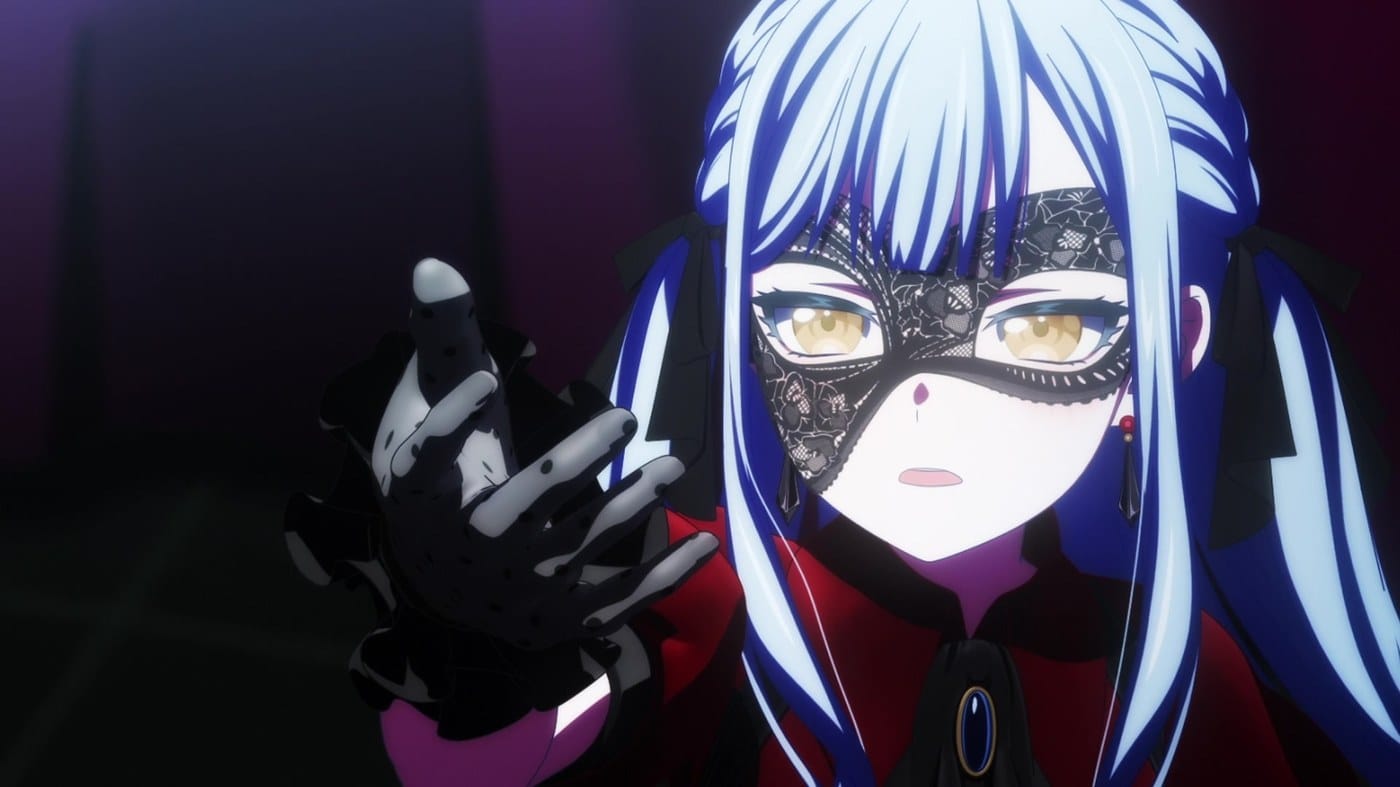
The theatrical release is an attempt to hold all of those masks up at once in a single venue. The cinema screen becomes the point at which the animated fiction, the musical catalog, the live-performance mythology, and the accumulated emotional investment of the fanbase converge. For the audience that has been inside the ecosystem long enough, that convergence is likely to be overwhelming in exactly the way Bushiroad intends. For anyone outside it, the masks are just masks — ornate, impenetrable, and offering no obvious way in.
What Success Looks Like Here
The question of whether this release succeeds cannot be answered by box-office gross alone, though the gross will be watched closely. The more useful metric is whether the theatrical moment strengthens the franchise's next cycle — whether the concerts that will inevitably follow, the game events that will tie in, the merchandise that will be produced, all carry more weight because the film existed as a shared communal experience for the fanbase. Idol-anime franchises are not evaluated like traditional media properties. They are evaluated like subscription ecosystems: the relevant number is not how many people bought in once, but how many stayed bought in.
BanG Dream! Ave Mujica is, in that sense, less a film than an argument — that the obsessive core of a niche multimedia ecosystem is not a liability to be managed on the way to mainstream acceptance, but an asset precise enough to be deployed on its own terms, in its own spaces, without apology. Today's theatrical opening in Japan and Taiwan is the opening statement of that argument. The verdict will take longer than a weekend to arrive.