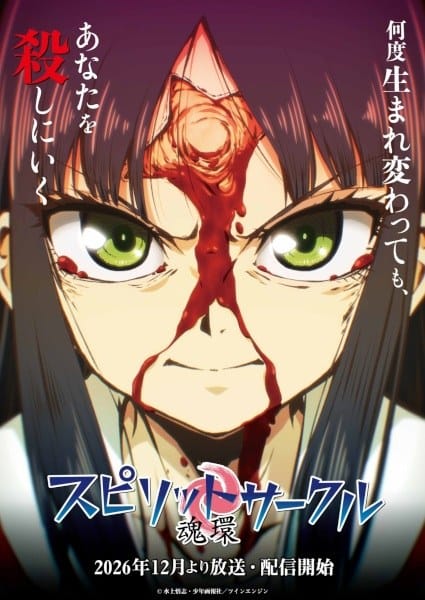
There is no clean way to announce a new anime when the director who made it is already gone. On November 5, 2026, REMOW revealed that Spirit Circle (2026), based on Satoshi Mizukami's beloved manga, would premiere worldwide in December — 18 episodes, full cast, first trailer. The announcement came bundled with a fact that immediately eclipses the production details: Anime News Network confirmed that director Tatsuo Sato, the man who shepherded this project from development to completion, died of liver failure on April 24, 2026. He was 61. Spirit Circle became his final work.
That detail reframes everything. An anime announcement is usually an overture — a promise of things arriving. This one arrives already carrying grief.
The Manga: A Cult Object That Resisted Easy Adaptation
Spirit Circle was serialized in Shōnen Gahōsha's seinen manga magazine Young King OURs from May 2012 to March 2016, compiled into six tankōbon volumes. Its creator, Satoshi Mizukami, is the same artist behind The Lucifer and the Biscuit Hammer and Sengoku Youko — a writer with a singular fixation on what it means to inherit a soul across time.
The story follows Fuuta Okeya, a 14-year-old boy who can see ghosts, and transfer student Kouko Ishigami. After Kouko notices the strange mark hidden beneath the bandage on Fuuta's cheek, she reveals that the two are connected through multiple past lives and begins targeting him over a grudge carried across reincarnations. The hook is deceptively simple. What Mizukami actually constructs is an anthology of past lives — ancient South America, medieval Europe, the ancient Orient — each one a complete moral universe in which Fuuta and Kouko are enemies, lovers, strangers, or some collapsed combination of all three. Reincarnation, along with the idea of humans having specific "destined" roles, runs throughout Mizukami's work, always presenting tension between what is predetermined and what a person can change.
By 2022, Spirit Circle had sold 250,000 physical copies — modest by blockbuster standards, significant for a six-volume seinen work without an anime engine behind it. Mizukami first serialized the manga from 2012 to 2016 in Young King OURs, and both Crunchyroll and Seven Seas Entertainment have licensed it for release in other regions. Its fandom is not enormous, but it is unusually intense — the kind of readership that returns to it and finds it changed, as good reincarnation fiction demands.
What made adaptation difficult, until now, was structural. Mizukami's past-life arcs require committing to full narrative detours — not flashbacks, but entire self-contained dramas that only retroactively reveal their meaning. A 12-episode cour can't hold that. A 24-episode split season can't hold it comfortably either. The anime will run for 18 episodes — an unconventional count that suggests the production shaped its length around the material rather than the other way around. That is a creative choice, and it points directly to the director who made it.
Tatsuo Sato: The Architect of Sincere Genre
Satō was born in Kanagawa prefecture on July 7, 1964. After graduating from Waseda University, he worked as an animator and assistant director at Ajiado. He came to prominence in 1996 with Martian Successor Nadesico — an epic 26-part space opera that was simultaneously a farcical comedy, targeted knowingly at fans of epic space opera. The series won the Best Work award at the 21st Anime Grand Prix and the Media Department Award at the 38th Seiun Awards. It was not a fluke. Sato had identified something specific about how self-aware genre fiction could operate: not in contempt of its conventions, but in full-throated affection for them, while still managing real emotional stakes.
That sensibility carried through his career. Satō directed Stellvia, Atom: The Beginning, Shigofumi - Letters from the Departed, Lagrange: The Flower of Rin-ne, and the Ninja Scroll television series, while serving as head writer and director for Bodacious Space Pirates and its theatrical film, as well as Martian Successor Nadesico: The Motion Picture – Prince of Darkness. He received a Seiun Award for Bodacious Space Pirates in 2012, serving as both director and series composer. His most recent completed works before Spirit Circle were Helck, which aired in 2024, and TASUKETSU, which aired in 2025.
Sato passed away on April 24, 2026, at the age of 61, due to liver failure while under long-term treatment. NAGOMI, the studio behind Spirit Circle, stated that he had continued working passionately on projects still in production prior to his death. The announcement of his passing came on May 7, 2026 — nearly two weeks after the fact, in keeping with the private family funeral that had already taken place. NAGOMI announced plans to hold a memorial gathering at a later date.
The specific pairing of Sato and Spirit Circle feels less like coincidence and more like recognition. This is a story about what people carry across lifetimes — guilt, love, old wounds, old debts. Sato's best work was always about the weight genre carries: the affection for a form, and what happens when that form is asked to hold something that actually matters. Late director Tatsuo Satō helmed his final work at studios NAGOMI × EOTA, as REMOW announced the 18-episode television anime adaptation of Spirit Circle, which will air in Japan and also stream globally in December.
The Production and What Arrives in December
Tatsuo Sato serves as director and series composer, with Kentaro Mizuno as assistant director, Satoru Fujimoto as character designer, and NAGOMI × EOTA handling animation production, with TWIN ENGINE as producer.
The cast is headed by Kazuki Ura as Fuuta Okeya, Anna Nagase as Kouko Ishigami, Eri Yukimura as Rune, and Yuichi Nakamura as East. Anna Nagase also performs the ending theme, marking her first solo vocal performance. The ending theme is titled "No Matter the World." The title is either accidental poetry or a deliberate editorial choice. Either way, it lands.
Streaming services have not yet been confirmed. For a manga already licensed internationally by Crunchyroll and Seven Seas, it would be surprising if no major platform picks it up for simulcast — but nothing is announced as of this writing.
What matters more than the platform is the question the production now poses to its audience. Every frame of Spirit Circle was supervised by someone who is no longer here to see it air. That is not a small thing. It places the anime in a tradition of posthumous works — not tragic precisely, because Sato clearly knew what he was making and pushed through illness to complete it, but weighted in a way that most anime simply are not. The story itself is about cycles, about the relationship between the living and what persists after them, about the difference between vengeance and understanding. It is difficult to read the production's circumstances as separate from that.
The question the adaptation has to answer is whether the material was given the space it needed — whether 18 episodes is the right answer, whether Sato's series composition holds the structural discipline the manga's past-life architecture demands. We will find out in December. What we already know is that this is the last thing one of anime's more principled genre directors made, and that the subject he chose for his final statement was a story about what endures when a person is gone. That is not an accident. That is a career.
For further reading on the anime industry's pioneer generation and its formal recognitions, see Kynari's piece on Rintarō being named a Person of Cultural Merit. And on what a manga's quiet ending can mean, see our coverage of Tetsuya Chiba's legacy and what a cartoonist leaves behind.