There is a specific kind of sell-out that matters in comics and a kind that does not. A book that blows through 10,000 copies at the distributor level on the Thursday before release is a solid launch. A book that burns through 250,000 copies before it has physically reached a single customer's hands is something else entirely — it is a statement about the shape of commercial trust in the direct market right now, and about one creator's particular place within it.
Image Comics confirmed on November 16, 2026 — two days before the book's scheduled New Comic Book Day release — that despite an initial print run of over 250,000 copies, Daniel Warren Johnson's highly anticipated Chainkata #1 had already sold out at the distributor level, ahead of its release date. Image is rushing Chainkata #1 back to print to keep up with the exceptionally high volume of reorder activity. The second printing and Chainkata #2 will both be available at comic book shops on Wednesday, December 23.
The number is worth sitting with. 250,000 copies is not a standard print run for a creator-owned debut at Image Comics. For context, Johnson's Transformers #1 premiere had laid waste to recent DC and Marvel launches with a chart-topping 150,000-copy instant sell-out that left a bevy of reprints in its wake. Chainkata (2026) has cleared that benchmark by 100,000 copies and still could not meet demand. That is the number Image is calling "the biggest launch of the year."
The Series
Chainkata is fully a Daniel Warren Johnson production — published November 2026, written and drawn by Johnson with colors by Mike Spicer, the series follows Luma, a chainsaw-wielding warrior queen seeking an unknown power in the vastness of space, blending the epic, high-stakes sci-fi of Beta Ray Bill and Space-Mullet with the character-building depth of Extremity and Do A Powerbomb. The title itself is a play on gun kata — from the Japanese word for form — or gun fu.
The series, which Johnson has been working on since 2017, follows Luma, a chainsaw-wielding warrior queen seeking out an unknown power in the vastness of space. Nine years in development for a debut issue. That compression of creative time into a single launch is reflected in both the product's confidence and in the market's response to it. Chainkata #1 lands with 40 ad-free pages for $3.99 — a price point that positions it as a generous opening salvo in an era when $4.99 and $5.99 debut issues have become routine.
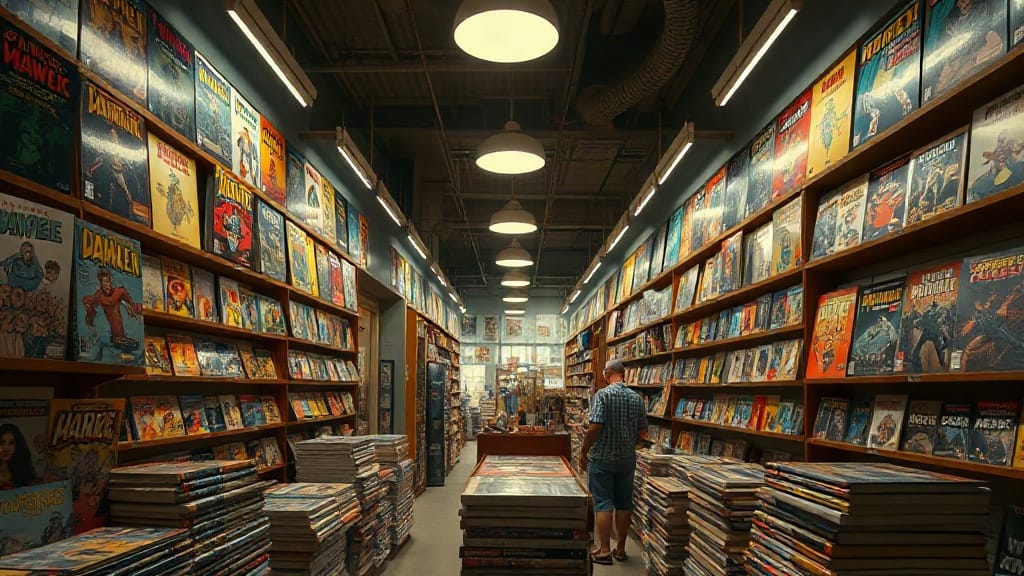
Chainkata was publicly revealed in early July ahead of San Diego Comic-Con 2026, with an exclusive ashcan containing the entire first issue at the Image Comics booth. The SDCC pipeline — ashcan previews, announcement trailers, convention floor signings — has become a reliable warmup engine for Image's highest-profile launches. By the time retailers placed their final orders in October, they were not guessing at an unknown property. They had seen the pages.
116 Shops Bet Big Before a Single Copy Shipped
The sell-out does not exist in a vacuum. It was structurally prepared by one of the more striking pre-launch retailer mobilizations in recent memory. Johnson's new Image Comics series had an unusually large variant-cover rollout, with 116 retailer-exclusive covers planned for the first issue, giving collectors a sprawling assortment of store-specific versions to chase before even counting the regular Image Comics covers and incentive variants.
The scale of the rollout made Chainkata #1 as much a cover-collecting event as a new-series debut. Shops including Third Eye Comics, East Side Comics, Dynamic Forces, Black Saber Comics, and KRS Comics — representing retailers from Chicago to the coasts — each committed artist fees and minimum order thresholds to produce exclusive editions. On these retailer-exclusive covers alone, the print run is almost 60,000. Those copies counted toward the initial 250,000 figure, and their existence signals something specific: retailers did not merely order Chainkata — they invested in it. The difference between placing an order and commissioning bespoke cover art is the difference between hedging and conviction.
The standard Image variants include a cover B black-and-white by Johnson, a cover C sword-and-sorcery by Johnson, a cover D by Riley Rossmo, a cover E by Rob Liefeld, a cover F blank sketch, a cover G 1:100 foil sword-and-sorcery by Johnson and Mike Spicer, a cover H 1:100 raw art by Johnson, and a cover I 1:1,000 original head sketch by Johnson. The 1:1,000 head sketch is a tier of incentive cover that only makes commercial sense at serious volume. Its presence in the solicitation confirmed that Image expected — and received — the kind of orders that justify it.
The Career That Built This Launch
None of this happens without the decade-long trajectory that precedes it. Johnson has received three Eisner Awards: Best Publication for Teens in 2023 for Do A Powerbomb, then in 2024 Best Continuing Series and Best Writer/Artist for Transformers. On July 26, 2024, Johnson won those two Eisner Awards for his work on Transformers, becoming the first author to receive this recognition for his involvement in the franchise.
That is not incidental decoration. Award wins in comics rarely move copy counts in isolation, but they function as market-legible credibility signals — particularly at the distributor and retailer level, where buying decisions happen months before readers touch the books. When Transformers (2023–2025) cleared 150,000 copies at launch and Do A Powerbomb (2022) won an Eisner, the industry made a note. When The Moon Is Following Us (2024–2025) followed with critical traction, that note became a running entry. By the time Chainkata solicited, retailers were not responding to hype — they were responding to a consistent, documented track record stretching back through Extremity (2017–2018), Murder Falcon (2018–2019), and Wonder Woman: Dead Earth (2019–2020).
The book marks Johnson's first series since his Transformers run concluded with issue #24 in September 2025. That gap of roughly fourteen months between the end of a chart-topping licensed run and the debut of a creator-owned original is precisely the kind of compressed breathing room that keeps an audience hungry without losing them. The market read the gap correctly.
What the Second Printing Tells Us
Image's decision to rush the second printing carries its own editorial logic. The second printing of Chainkata features three new covers by Johnson, Tyrell Cannon (The Shlub), and a manga-inspired cover by JB Roe. Three distinct aesthetic directions — Johnson's own house style, a Chicago-local alternative voice, and a manga-inflected design — suggest that Image is not simply reprinting to meet overflow demand. It is using the second printing as a secondary launch, one timed to arrive simultaneously with Chainkata #2 on December 23. That pairing ensures that readers who missed issue #1 on the first pass can catch up and continue in the same retail visit. It is clean commercial architecture.
The manga cover by Roe is worth noting in its own right. Chainkata's premise — a kinetic, emotionally charged warrior-queen narrative drawn with Johnson's signature expressiveness — is not far in spirit from the shonen action genre. The decision to include a manga-coded cover for the second printing is both a collector's gambit and an acknowledgment of where a portion of this audience lives culturally. It is a small signal, but signals are what second printings are made of.
What the sell-out of Chainkata #1 ultimately measures is not enthusiasm — enthusiasm is easy to manufacture with enough variant covers and convention presence. What it measures is the depth of commercial confidence the direct market has placed in a single creator. Graphic Policy framed it plainly: 250,000 copies ordered and still not enough. That is a retailer network telling you, without ambiguity, that they believe a creator-owned science-fiction comic about a chainsaw-wielding warrior queen will walk out of their stores on the strength of one name alone. For a creator who started with a self-published webcomic in 2012, that is not a small thing. It is the whole thing.
For more on how the comics direct market is calibrating its bets on creator-driven launches, see our coverage of Joe Kelly's post-milestone Amazing Spider-Man arc finding its footing and how Zdarsky's Avengers #1 landed at a different kind of launch moment.