Most people who have played an ARIKA game never learned the names of the people who made it run. Akira Kurabayashi was one of those names. A board director at the studio and head of its software development department, he died suddenly of heart failure on November 14, 2026, the company announced on November 17. His career ran from Taito's arcade boards in the mid-1990s to the online battle royales that put Tetris and Pac-Man in front of a new generation on Nintendo Switch.
The notice, published on ARIKA's official website and signed by the company's founder and representative director, Akira Nishitani, describes a programmer who stayed "at the forefront" as the industry moved from 2D to 3D, from arcades to home consoles and on to online play. That is as close to a thesis as an obituary for an engineer gets.
From Taito's arcades
Before ARIKA, Kurabayashi was a game programmer at Taito Corporation. According to the studio's announcement, he served as lead programmer on Darius Gaiden (1994), the fifth entry in Taito's horizontal shooter series, and on the fighting game Fighters Impact (1996). It was arcade work, built for machines where performance is not a detail but the whole product, and it was the grounding he would carry to his next job.
The studio of 3D Street Fighter
ARIKA was founded in 1995 by former Capcom staff led by Akira Nishitani, one of the creators of Street Fighter II; the company's name is an anagram of his first name. Its debut was Street Fighter EX, the Capcom-licensed game that took the series into three dimensions, and ARIKA's credit list for Kurabayashi begins there: the Street Fighter EX series from 1996 onward.
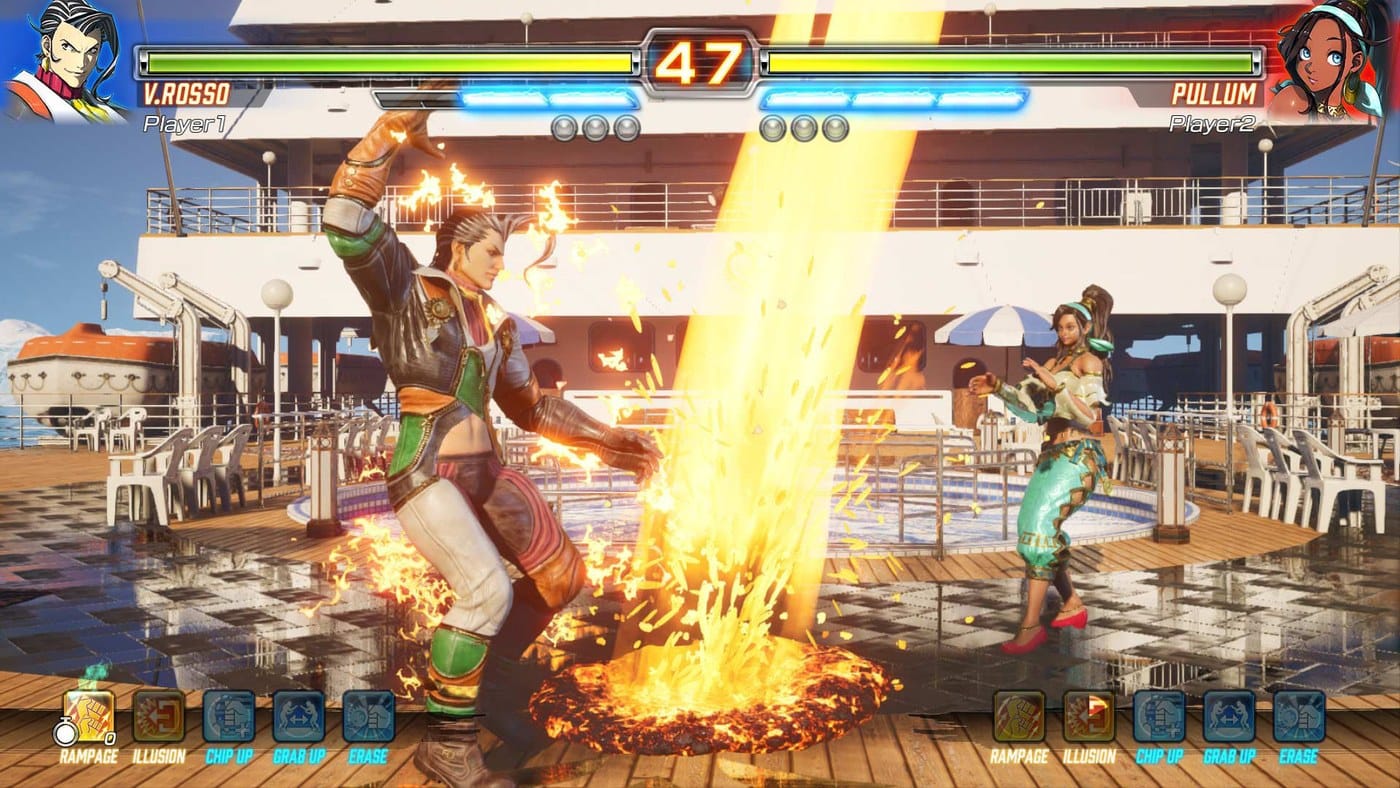
The EX games occupy an odd place in fighting-game history. They were licensed Capcom products built by an outside studio, with original characters such as Skullomania and Hokuto who outlived the licence. Kurabayashi's credits follow that lineage directly: Fighting Layer (1998), the Namco-published arcade game built on the EX foundations, and the Fighting EX Layer series from 2018, ARIKA's own continuation of those characters without the Capcom name attached. When the studio wanted to keep a 20-year-old cast alive on modern hardware, its head of software was part of the work.
The same years produced Tetris The Grand Master (1998), ARIKA's notoriously demanding arcade take on Tetris, which the studio's announcement also lists among his projects, along with Druaga Online: The Story of Aon (2006).
Under the sea
The calmer side of ARIKA's catalogue carries his name too. The announcement credits him on Everblue (2001) and on the Forever Blue games of 2007 and 2009, the Nintendo-published Wii diving titles known in the West as Endless Ocean and Endless Ocean: Blue World. They were games about drifting, observing and cataloguing fish, as far from a frame-tight fighting game as it is possible to get, and the fact that one engineering department built both says a great deal about the studio Kurabayashi helped to run.
ARIKA's wider catalogue in those years also includes Mega Man Network Transmission (2003) for Capcom and, much later, Endless Ocean Luminous (2024) for Nintendo. The studio's notice does not list them among his credits, so they are best read as the company he helped shape rather than as his personal work.
The "99" games
For many younger players, ARIKA is simply the studio behind Tetris 99 (2019) and PAC-MAN 99 (2021), the battle royales that dropped 99 players into a single classic game on Nintendo Switch. ARIKA describes both as online competitive titles to which Kurabayashi contributed. Keeping 99 simultaneous players in sync, with every line cleared or ghost eaten turning into an attack on someone else's screen, is exactly the kind of problem that never appears on a box but decides whether a game works at all.
The announcement also lists a 2024 collaboration project with SNK among his work, and notes that the titles named are "only a selection" of those he contributed to.
What the studio said
The statement, in its English translation, calls Kurabayashi's technical skills, experience and passion for game development "irreplaceable assets to our company," and adds: "We are deeply saddened to have lost a valued colleague who helped create so many titles and supported Arika for many years." The company says it will "carry forward the technical skills, experience, and approach to game development that he left us." A farewell gathering is planned at the request of his family.
Coverage from EventHubs and Shacknews has focused on the two ends of his career, fighting games and the "99" series. Seen together, they describe a rare continuity: one engineer working at the same studio for roughly three decades, across arcade cabinets, home consoles and online play, on games built by and for people who care about how a game feels in the hands.
The quiet credit
Game programmers rarely become public figures, and Kurabayashi does not appear to have sought to be one. His legacy is the kind you feel rather than read: a combo that connects on the right frame, a dive that loads without a stutter, a 99-player match that holds together until the last block falls. Fighting-game fans who still play Street Fighter EX characters in Fighting EX Layer, and anyone who has spent a lunch break in Tetris 99, have used his work, whether or not his name ever reached them. It should have.