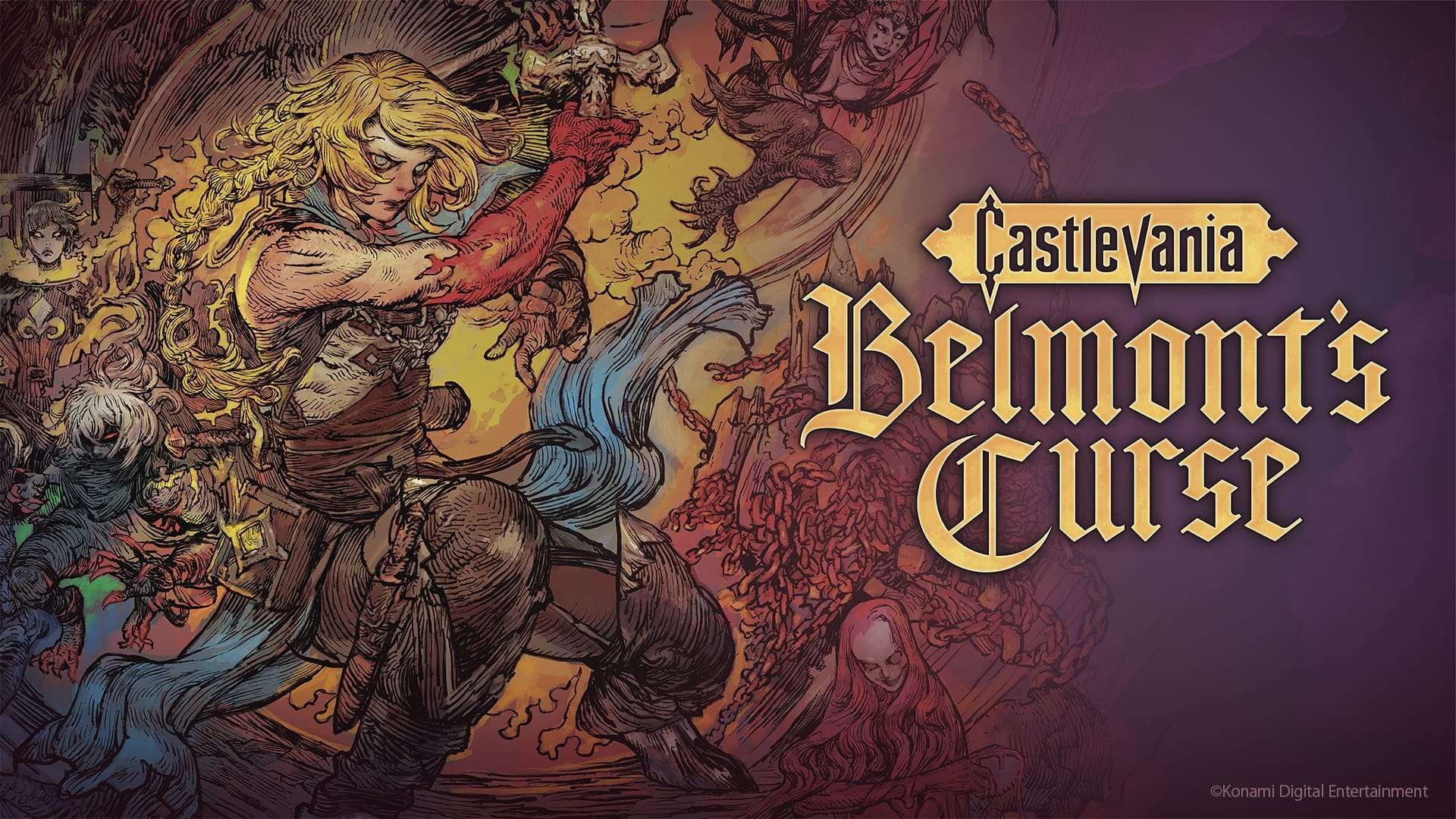
There is a particular kind of pressure that comes not from expectation but from irrelevance. Castlevania: Belmont's Curse (2025) arrives into a release window that is, by any commercial logic, a graveyard. Boltgun 2 dropped the day before, capturing every inch of the retro-shooter conversation. Grand Theft Auto VI looms one week out, its pre-release blackout already pulling the oxygen from every other discussion in games media. Konami and Evil Empire did not schedule this release accidentally. They scheduled it because the alternative — going head-to-head with Rockstar — would have been a different kind of death.
 Official trailer
The question is not whether Belmont's Curse is a competent game. Early coverage suggests it is more than that. The question is what it reveals about the state of legacy Japanese IP, the economy of franchise rescue, and the increasingly uncomfortable arrangement in which Western studios are handed the keys to cultural properties their developers grew up importing on cartridges.
The Studio and Its Inheritance
Evil Empire is a Bordeaux-based developer best known for inheriting Dead Cells (2018) from Motion Twin and transforming what was already a critically acclaimed roguelite into one of the most aggressively supported games of the last decade. Before that, their foundational DNA was forged in the long, troubled rehabilitation of Prince of Persia — a franchise Ubisoft had run into the ground with diminishing sequels and a catastrophically misread 2008 reboot that the market punished despite being, in retrospect, genuinely interesting. Evil Empire understood that the way to save a dead brand was not nostalgia cosplay. It was structural reinvention that kept the emotional grammar intact.
That philosophy, applied to Dead Cells, produced something remarkable: DLC expansions that doubled the game's scope without diluting its identity, and a post-launch relationship with players that made the studio synonymous with stewardship. When Konami approached them for Belmont's Curse, they were not hiring a mercenary. They were hiring the only Western studio with a documented methodology for this exact problem.
The problem, stated plainly: Castlevania has been commercially dormant since Castlevania: Lords of Shadow 2 (2014), a MercurySteam production that sold respectably and was received with the kind of polite disappointment that is harder to recover from than outright failure. Since then, the IP has survived primarily as a Netflix animated series — critically beloved, narratively ambitious, and entirely disconnected from any interactive product. The franchise's cultural presence has been maintained by a medium it doesn't control, which is a precarious position for any game property.
What "Rescue" Actually Costs
There is an unspoken transaction in franchise rescue work that the industry rarely examines directly. When a Western studio revives a Japanese IP — particularly one carrying the weight of the 16-bit and PS1 eras — it inherits not just a design language but a fandom whose relationship with the property is fundamentally devotional. Castlevania fans are not consumers waiting to be satisfied. They are curators of a specific feeling: gothic architecture rendered in pixel art, a whip's arc against a chandelier, Simon Belmont's stiff, deliberate walk. These are not mechanics. They are liturgy.
Evil Empire knows this. Their work on Dead Cells: Return to Castlevania (2023) — a crossover DLC that brought the Belmont aesthetic into their own game — was essentially a public audition. It was meticulous, reverent, and commercially successful enough to confirm what Konami had presumably already decided: this was the studio. The DLC read less like licensed content and more like a job interview conducted in front of two million players.
What Belmont's Curse costs Evil Empire is the freedom that defined their best work. Dead Cells under their stewardship succeeded partly because Motion Twin had established the core IP with enough critical distance from nostalgia that Evil Empire could expand it laterally without triggering the defensive reflexes of a traumatized fanbase. Castlevania offers no such distance. Every design decision will be read as either betrayal or obeisance.
The Timing Is the Message
Release windows are editorial statements. Launching one day after Boltgun 2 (2025) and one week before GTA VI's media lockdown is not an accident of the calendar — it is a calculated positioning that tells you exactly who Konami believes this game is for. Boltgun 2 serves the same retro-revival appetite but targets a different emotional register: the boomer shooter crowd, the PC faithful, the people who want speed and brutalism. Belmont's Curse wants the players who will sit with a game, who will read item descriptions, who respond to atmosphere as a primary mechanic.
The GTA VI blackout is a different kind of pressure. In the week before a Rockstar release, games media does not stop publishing — it publishes defensively, filling space with coverage that everyone knows will be buried the moment the embargo lifts. Launching into that window is a bet that your game's audience has already opted out of the Rockstar news cycle, that they are specifically looking for something that operates at a different frequency. It is, in a perverse way, a compliment to the Castlevania audience: Konami is betting that they are not the people who will drop everything for GTA VI.
That bet may be correct. It may also be a rationalization for a release date that was never going to be ideal, dressed up as strategic positioning after the fact. Both things can be true simultaneously.
What Konami Is Actually Doing
The broader pattern here is worth naming. Konami's recent history with its legacy IP has been a series of cautious experiments conducted at arm's length from its own internal studios. Castlevania goes to Evil Empire. Metal Gear is processed primarily through licensing and pachinko revenue. Silent Hill has been distributed across multiple external developers simultaneously, a strategy that hedges risk so aggressively it borders on incoherence. The through-line is not revival — it is outsourcing the risk of failure onto studios that have their own reputations to protect, while Konami retains the upside if the IP performs.
This is not cynicism for its own sake. It is a structural observation: Konami is no longer a developer in the traditional sense. It is an IP holding company that occasionally licenses production rights to studios capable of doing what it no longer has the institutional will to do itself. Evil Empire gets creative latitude, a famous brand, and whatever marketing budget Konami has committed. Konami gets a new Castlevania without having to rebuild the internal expertise that produced the originals.
Whether Belmont's Curse is good — and early indications suggest it is, architecturally dense and mechanically considered in ways the franchise has not been in a decade — is almost secondary to this arrangement. The game exists as proof of concept for a model of IP management that will define the next era of Japanese legacy publishing. If it succeeds, every dormant Konami franchise becomes a candidate for the same treatment. If it fails, the franchise goes back into suspended animation, waiting for the next studio willing to carry the weight of someone else's history.
Evil Empire has done this before. The difference is that this time, the history belongs to everyone who grew up with it — and that is a much harder thing to give back.