Numbers at this scale tend to detach from reality on contact. One hundred billion is too large to hear, too abstract to feel, and streaming counts offer no sensory anchor — no physical weight, no visible crowd, no stack of records. And yet when independent trackers ChartMasters and Kworb confirmed that The Weeknd had crossed 100 billion Spotify streams across all credits, the pop culture industry paused. Because the number does mean something — just not necessarily what the headlines say it means.
The milestone was logged by ChartMasters on September 30, 2026, making The Weeknd — born Abel Tesfaye in Toronto — only the fourth artist to clear this threshold on the platform. The three ahead of him, according to ChartMasters' all-credits leaderboard, are Drake, Taylor Swift, and Bad Bunny. The fifth-place artist, Justin Bieber, sits at roughly 79 billion. The gap is not small. The Weeknd's achievement isn't a rounding error at the edge of an already crowded tier — it is entry into a genuinely rarefied band.
The composition of that 100 billion matters. According to ChartMasters data, approximately 91 billion of those streams come from tracks on which he is the lead artist, while roughly 10.7 billion derive from featured appearances and collaborations. Kworb's methodology produces a slightly different architecture — it counts him at over 100 billion total, with lead streams, solo streams, and feature streams broken out separately — but both platforms converge on the same headline figure. The variance between trackers is methodological, not factual: both are working from Spotify's public-facing play counts, since, as these trackers note, Spotify does not officially publish cumulative all-time artist totals.
That caveat is worth sitting with. The milestone that the music press is celebrating is an estimate — a rigorous one, updated daily by credible independent tools, but an estimate nonetheless. Spotify has not confirmed the figure. The company's own Spotify Wrapped campaigns give annual snapshots but no running all-time totals. What ChartMasters and Kworb have built are essentially shadow ledgers, aggregating public stream counts at the track level and summing them upward. That they agree closely enough to anchor a cultural moment says something about the maturity of fan-driven data infrastructure. It also says something about the platform's opacity — that the most significant number in a streaming artist's career is one the platform itself will not formally certify.
The Catalogue Engine
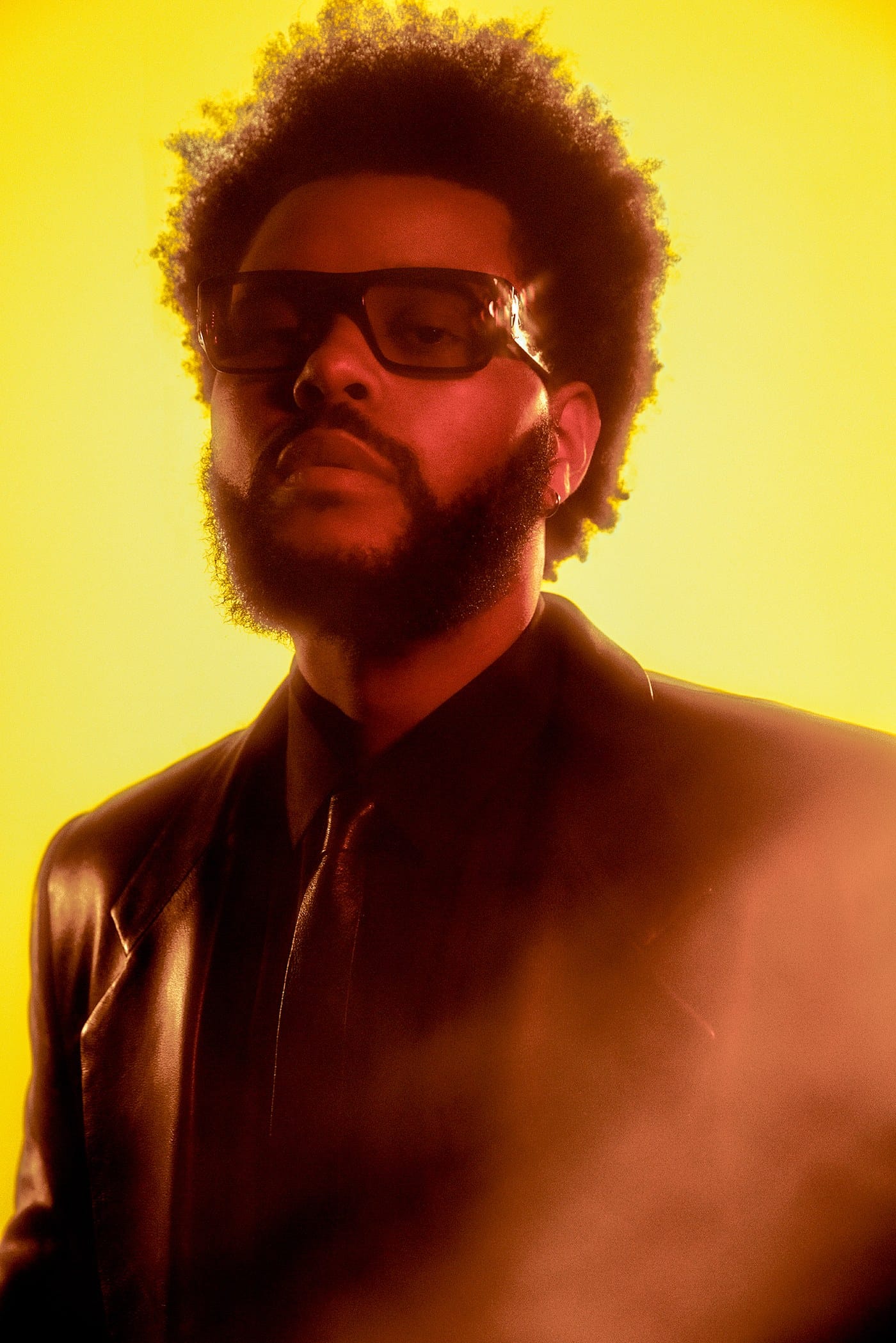
The more structurally interesting question is how The Weeknd got here, and what that reveals about the streaming era's relationship with time. He released his sixth and reportedly final studio album under the name, Hurry Up Tomorrow (2025), on January 31, 2025 — a 22-track close to the After Hours/Dawn FM trilogy that opened first-week in the United States with 490,500 album-equivalent units. The album accumulated over 4.5 billion Spotify streams by late October 2026. That is a substantial contribution. But it is not the engine driving the 100-billion figure.
The engine is older. After Hours (2020) remains The Weeknd's most-streamed album, with cumulative Spotify streams approaching 5 billion on its own. And anchoring the entire catalogue is Blinding Lights — the lead single from that record, released in November 2019 — which ChartMasters now tallies at approximately 5.68 billion streams, making it the most-streamed song in Spotify's history. It is also, per Kworb's tracking, the first song ever to surpass five billion streams on the platform. Blinding Lights alone accounts for roughly 5.6 percent of The Weeknd's entire all-credits total. One song from 2019 is still logging over a million streams per day in late 2026.
This is the streaming era's central paradox: the catalogue feeds the present. Blinding Lights did not peak in its release year and fade. It reached the number-one position on Spotify's all-time chart in January 2023, overtaking Ed Sheeran's Shape of You (2017) only after three-plus years of compounding daily plays. It became the first song to cross four billion streams, then five billion — not through virality in the conventional sense, but through algorithmic re-exposure, editorial playlist rotation, sync placement, and the year-on-year weight of Spotify Wrapped surfacing it to new listeners. The song became a franchise, in the language of platform economics: a recurring asset that generates revenue without requiring promotional spend.
The Weeknd's position in the 100-billion club reflects this logic at scale. He holds 28 songs with over one billion streams each on Spotify — a figure that places him second all-time by that metric, per ChartMasters. That means his catalogue has extraordinary depth: not one or two tent-pole tracks carrying an otherwise thin back catalogue, but nearly thirty songs each of which qualifies as a streaming event in its own right. "Starboy," "Save Your Tears," "The Hills," "Call Out My Name," "Earned It" — across collaborations and solo work, across the mixtape era and the stadium era, the breadth is genuine.
What the Number Doesn't Measure
The featured-credit component of the total — over 10 billion streams, per both trackers — introduces a complication the headline number elides. Those streams include his appearances on other artists' tracks, songs where he may have written a verse or sung a hook but where the sonic and commercial context belongs to someone else. Including them in an artist-total milestone is legitimate as a methodology, but it means the 100-billion figure is a measure of cultural presence rather than strictly of an artist's body of work. The Weeknd as collaborator, as a voice borrowed to elevate another track, counts equally with The Weeknd as auteur. That is probably correct — his featured performances on tracks like "Or Nah" (Ty Dolla $ign remix) have generated well over a billion streams — but it complicates simple comparisons between artists with different collaborative philosophies.
There is also the unresolved question of what a stream represents. Spotify counts a stream after 30 seconds of listen time. It does not distinguish between active listening, background play, playlist-auto-continuation, and sleep-timer loops. The 100-billion number cannot be disaggregated into attention-hours versus ambient accumulation. This is not a critique specific to The Weeknd; it applies to every streaming figure. But at the scale of 100 billion, the ambiguity becomes structural: this number is the music industry's primary performance metric, and it measures something fuzzier than attendance or units sold ever did.
What it does measure, with precision, is persistence. The streaming economy rewards music that people return to — that survives the algorithm's churn of new releases long enough to become habitual. Blinding Lights was released during a period when new music was arriving at a rate of approximately 60,000 tracks per day on Spotify. That a single song from that period has now accumulated over 5.6 billion streams is a statement about longevity in a system designed for novelty. It is also a statement about the specific register of The Weeknd's songwriting: cinematic, emotionally unambiguous in its surface texture while remaining lyrically interior, R&B-rooted but produced for maximum arena applicability.
Hurry Up Tomorrow — framed by Tesfaye as his probable final album under the moniker — reportedly inspired partly by losing his voice on tour in 2022 — arrived into this context as a commercial and artistic summation. Its Grammy shutout, despite Republic Records running a formal campaign, demonstrated that institutional recognition and streaming dominance have fully decoupled in the current era. The Weeknd's feud with the Recording Academy dating to 2021 colored the narrative, but the structural point stands regardless: 100 billion streams and zero Grammy nominations can coexist without contradiction. The audiences and the academies are not watching the same thing.
The three artists ahead of The Weeknd on ChartMasters' all-credits leaderboard each illustrate a different variant of the same logic. Drake's total of roughly 144 billion leans heavily on featured credit accumulation — he is one of the most prolific collaborators in pop history. Taylor Swift's position reflects re-recorded catalogue strategy and the ecosystem of an unusually devoted fanbase. Bad Bunny's presence at the top tier represents the streaming platform's global reach: a Spanish-language artist with cross-continental saturation. The Weeknd's 100 billion is built primarily on a core of English-language R&B with crossover production values — a narrower lane, in some respects, that makes the total more remarkable.
The number is real. Its meaning is conditional. And the conditions — platform opacity, methodological variance between trackers, the blunt instrument of a 30-second threshold, the blending of active listening with ambient accumulation — are inseparable from the milestone. One hundred billion streams confirms, beyond any reasonable doubt, that Abel Tesfaye built one of the most enduring catalogues in the streaming era. It does not tell us how many people actually listened. That distinction matters less and less, which may be the most revealing thing the milestone has to say.