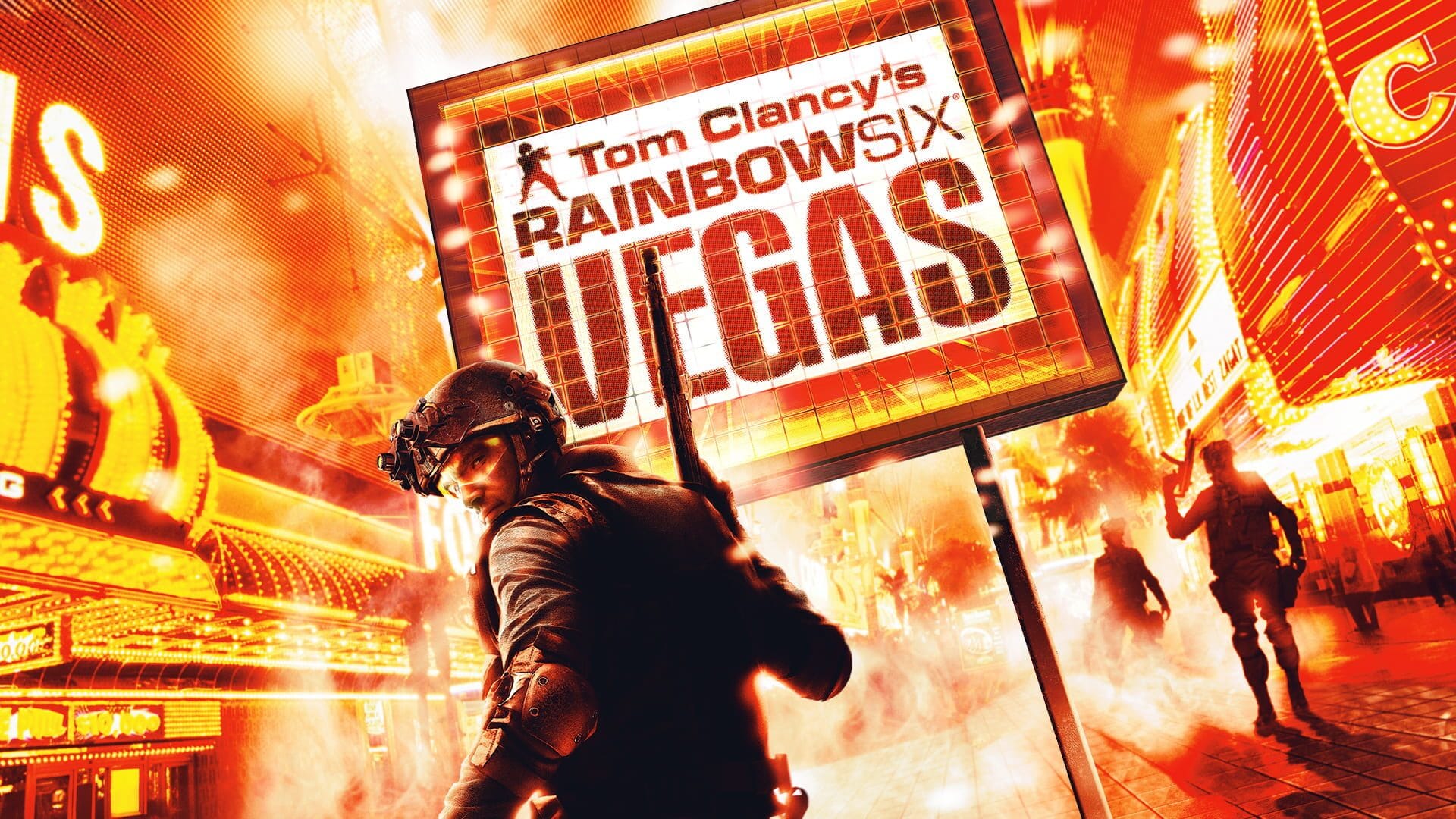
Seventeen years is a long time to leave Las Vegas. Tom Clancy's Rainbow Six: Vegas 2 (2008) was the last time Ubisoft Montreal sent Team Rainbow to strip-crawl through neon-lit casinos and high-rise corridors, and in the interim the studio pivoted hard into the competitive multiplayer era that produced Tom Clancy's Rainbow Six Siege (2015). Now, Insider Gaming reports that Ubisoft Montreal has quietly greenlit a new entry in the Vegas sub-series, internally codenamed Spades, and that it is almost certainly a direct sequel — Vegas 3 — rather than a remake of the originals.
The report, broken by Insider Gaming co-founder Tom Henderson, is as lean on confirmed detail as you would expect from a project this early. The project is in the very early stages of production, with concept work and prototyping only recently getting underway. It is one of three new projects being spun up at Ubisoft Montreal — the studio behind both Vegas games and Siege — and Henderson's sources say another of the three is also set in the Rainbow Six universe. The title is expected to serve as a direct sequel and the third mainline entry in the sub-series, following 2008's Vegas 2, with story, gameplay mechanics and target platforms remaining under wraps. Given its early development status, a full release is unlikely within the next couple of years.
What the report cannot suppress, however, is what it implies structurally. The question worth asking is not whether Ubisoft is making another Vegas game — the answer appears to be yes, in some form — but why that decision is being made now, inside the institutional architecture it is being made in.
The Vantage Studios Variable
Spades is not simply a Ubisoft Montreal project. It is, by all accounts, a Vantage Studios project. Vantage Studios is the new creative house launched jointly by Ubisoft and Tencent to take responsibility for the future of Ubisoft's Assassin's Creed, Far Cry, and Rainbow Six properties. Tencent holds a 25% minority stake in the new subsidiary, following an investment of 1.16 billion euros. Co-CEOs of Vantage are Charlie Guillemot — son of Ubisoft CEO Yves Guillemot — and Christophe Derennes, a Ubisoft veteran of more than 35 years.
The formation of Vantage reframes how to read any project operating under its umbrella. Studio employees have said the newly formed entity will have complete creative and business control over the three franchises. Ubisoft's stated goal is to allow "a higher level of autonomy for developers and a shorter pathway between gathering and implementing player feedback." That language of autonomy matters here. A Vegas 3 greenlit inside a structure purpose-built for creative independence and long-term brand stewardship looks different from a Vegas 3 greenlit reactively, say, to plug a release-window hole. Spades, if it reaches production in full, will be a Vantage conviction — not a gap-filler.
With Spades potentially arriving alongside Rainbow Six Tactics, Ubisoft appears to be deliberately exploring different directions for the franchise simultaneously. Two Rainbow Six projects in parallel, one competitive and systemic, one (presumably) narrative and authored, is not an accident. It is a portfolio strategy.
What Vegas Was, and Why It Was Abandoned
The original Tom Clancy's Rainbow Six: Vegas (2006) was itself a reinvention. A reboot of sorts for the Rainbow Six series, it dropped the player into a fictional version of Las Vegas to stop a terrorist plot. The games put emphasis on squad commands and the concept of taking cover and firing from behind it, rather than running and gunning. The original game won numerous awards, was praised for its story and environments — taking the player from desert levels to high-roller casinos — and its multiplayer mode won multiple 'Best Online' awards for its experience system and customization options.
Destructoid's corroboration of the story, arriving within 48 hours of Henderson's exclusive, underlines the credibility of the report across the industry. The speed of that confirmation cycle matters: sources close enough to independently verify an early-development greenlight suggests Spades has circulated internally beyond a small core team.
After Vegas 2, the franchise's story-driven wing went dark. Ubisoft worked on over a dozen Rainbow Six projects since, but none carried the Vegas name. Tom Clancy's Rainbow Six: Patriots, a narrative-heavy follow-up in development at Ubisoft Montreal, was eventually cancelled in 2014 and replaced by what became Siege. The competitive multiplayer format of Siege then absorbed all creative oxygen in the franchise for a decade.
Siege's numbers justify that decade of focus — to a point. The game has accumulated over 70 million registered accounts across all platforms. Player counts peaked in March 2024, when over 200,000 concurrent Steam users actively played it. But the game has undergone a steady decline since 2021, and by mid-2025 the peak concurrent player count on Steam had decreased by approximately 70% from its 2021 peak. Siege is still alive — the Siege X update in June 2025 produced a meaningful surge — but the ceiling is visibly lower than it was. That trajectory, more than any nostalgia calculus, is probably what made a Vegas revival argument feasible inside Vantage's boardrooms.
The Extraction Shadow
Any honest accounting of this moment has to pass through Tom Clancy's Rainbow Six Extraction (2022). The cooperative alien-horde shooter, which grew out of Siege's limited-time Outbreak mode, was widely regarded as a commercial and critical disappointment. Critics cited it as an asset flip with very little depth. Player counts lowered to the point that Ubisoft had to officially confirm it was not cancelling the title. Extraction's failure demonstrated, with some clarity, that the Rainbow Six brand does not automatically transfer to any genre or format Ubisoft attaches it to. Players who loved Vegas were not waiting for aliens — they were waiting for authored missions, real-world threat scenarios, a protagonist with a name, and a story that ended.
Spades, if sources are right that it leans toward Vegas 3 rather than a remake, would represent a correction: a return to the formula that actually built the sub-series' legacy. That is the safer creative bet, even if it carries significant budget risk in a genre — single-player-adjacent, narrative tactical shooter — that the market has become less forgiving of when execution is merely adequate.
Reading the Codename
Spades is a card suit. Vegas was a city of card games. The codename is either a thematic wink or a coincidence, and in game development, very few things are coincidences. What is not coincidental is that Ubisoft Montreal — the very studio behind the original two entries — is leading the project. Institutional memory matters in sequel development. The people who built Vegas's cover system, its pacing, its tone, may still be in that building. Continuity of creative DNA is Vantage Studios' stated reason for existing.
The piece of this that remains most opaque is what a Vegas game looks like in 2026 and beyond. Details regarding story, gameplay mechanics and target platforms remain under wraps. Does Spades retain the linear campaign structure that defined the original two games, or does Vantage attempt to graft on some live-service layer to justify the investment? Does Logan Keller return, or does the sequel introduce a new protagonist while honoring continuity? Those questions will not be answered for years. What we know, right now, is that the conversation is happening — and that it is happening at the most consequential structural moment in Ubisoft's recent history.
For a franchise whose story-driven half has been dormant since the first Obama administration, that is not nothing. Ubisoft's challenge is ensuring that by the time Spades reaches a reveal, the industry still has an appetite for what Vegas was. That risk is not unique to them — legacy single-player franchises are navigating the same question across the board. But Vegas carries a specific kind of goodwill, the kind earned by games that were genuinely fun at a moment when fun was not taken for granted. Spending that goodwill well will require more than a codename and a greenlight. It will require the full weight of a studio that remembers why people cared in the first place — and a publisher structure finally reorganized to let them act on that memory without interference.
Vantage Studios was built, ostensibly, to be exactly that structure. Spades may be the first real test of whether the promise holds.