On July 10, 2026, Palworld (Palworld, 2024) left Early Access with 855,000 concurrent players on Steam. Not a relaunch. Not a sequel. The same game that launched in January 2024 on the back of chaos, copyright accusations, and the internet's most exhausting debate about creative originality — still here, still pulling numbers that most AAA studios never see at launch, let alone two and a half years later.
That figure alone demands analysis. The 1.0 milestone isn't a formality. It's evidence of something more structurally interesting: a 60-person studio sustaining a cultural phenomenon across a window in which most live-service games, staffed by teams ten times larger, quietly shut down their servers.
What 1.0 Actually Delivers
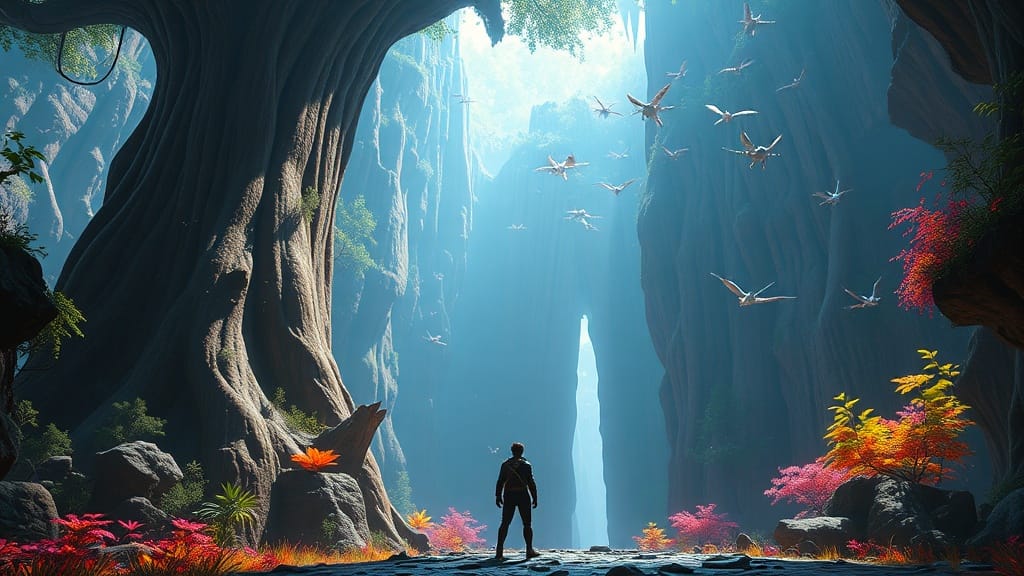
The version 1.0 release is not a cleanup patch dressed in ceremony. Pocketpair shipped the World Tree region — a vertical, densely layered biome built around the game's central mythology that the Early Access roadmap had been gesturing toward since launch. It's the kind of content addition that recontextualizes the map rather than simply extending it. Alongside it: full PvP infrastructure, finally formalized after months of experimental modes, and 72 new Pals that push the total roster deep enough to constitute genuine ecological worldbuilding rather than a collectible checklist.

The design logic is consistent with how Pocketpair has operated throughout Early Access — each major update expanding a system rather than decorating it. PvP isn't a mode bolted onto a creature-collector; it's integrated into the faction and base-building mechanics that define Palworld's mid and late game. The World Tree region isn't a new skin over existing terrain; it introduces vertical traversal demands that change how players deploy their Pals in exploration. At 1.0, the game feels architecturally complete in a way that Early Access, by definition, could not.
The Nintendo Lawsuit: A Controlled Demolition
The legal dimension of Palworld's story has reached its conclusion, and it is almost aggressively anticlimactic. Nintendo's lawsuit — filed in September 2024, citing patent infringement related to mechanics involving creature capture and traversal — has settled at an estimated compensation of approximately $30,000. In the context of a game that generated hundreds of millions in revenue within its first month of Early Access, that number is not a fine. It is a rounding error.
The settlement's scale matters beyond the symbolic. Nintendo's legal intervention was widely read, in the months after its filing, as a potential existential threat — or at minimum, a mechanism that could force Pocketpair into costly mechanical redesigns. Neither happened. What the outcome demonstrates instead is the structural difficulty of applying patent law to game mechanics, a space where prior art is abundant, definitions are contested, and courts have historically shown limited appetite for broad enforcement. Nintendo has prevailed in the sense that a settlement exists. Pocketpair has prevailed in every other sense.
The lawsuit's collapse into irrelevance is not an endorsement of Palworld's originality — a debate that was always more cultural than legal. It is a data point about the limits of IP litigation as a competitive tool in the games industry, and about the specific difficulty of targeting a phenomenon once it has already achieved cultural mass.
The Structural Argument
What makes Palworld 1.0 genuinely significant isn't the concurrent player record, though 855,000 is a number that concentrates the mind. It's the demonstration that the studio built something with enough mechanical depth to sustain a playerbase across a multi-year development cycle — without a battle pass, without a live-service monetization engine, without the infrastructure that the industry has spent a decade arguing is necessary for retention at scale.
Pocketpair's team of 60 people achieved this through a relatively unfashionable method: shipping systems that work, expanding them coherently, and letting the game's inherent density do the retention work. That is not a scalable industry lesson — most games don't have Palworld's specific combination of genre-blending and cultural timing. But it is a refutation of the idea that only certain kinds of studios, with certain kinds of resources, can sustain a live game through to completion.
At 1.0, Palworld is no longer a phenomenon in progress. It is a completed artifact — one that survived a legal challenge from one of the most litigious IP holders in entertainment, a two-and-a-half-year development runway, and the notoriously short attention span of the internet. The 855,000 players who showed up on July 10 weren't there for nostalgia. They were there because the game earned it.
 Official trailer