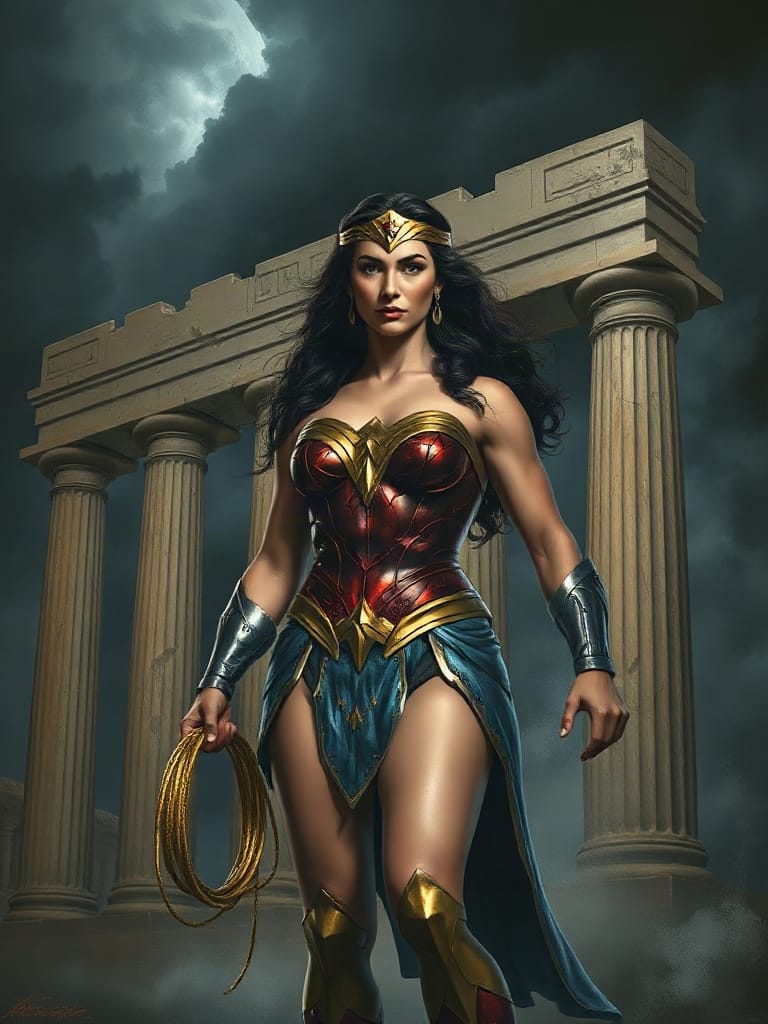
There is a particular kind of ambition in choosing depth over width. Most comic publishers, when they want an event to feel large, reach outward — crossover tie-ins, variant covers, checklist completionism dressed up as narrative consequence. DC is doing something measurably different with the second act of "The Wonder War," and the structural evidence is sitting right in the solicitations: Wonder Woman (2023) #37 launches the arc this week from Tom King and Daniel Sampere, and on September 30 a 48-page annual arrives, co-written by Stephanie Phillips Williams and Leah Williams, built entirely around Matriarch — the arc's central villain. Two books. One story. No sprawl required.
That choice is not incidental. It is architectural.
What "The Wonder War" Actually Is
King's run on Wonder Woman has been one of the more politically legible superhero comics of the current decade — a sustained meditation on nationalism, mythology, and the cost of being a symbol in a country that keeps redefining what symbols are allowed to mean. Diana Prince has been arrested, exiled, declared a foreign threat, and made to fight for her right to exist on American soil. The first act of "The Wonder War" escalated those themes into something approaching open conflict. Act 2 raises the stakes, but King's instinct — consistent across his runs on Batman (2016) and Mister Miracle (2017) — is to raise emotional stakes before logistical ones.
Sampere's visual language serves that instinct precisely. His pages move between monumental composition and intimate close-up with a fluency that few artists working in mainstream superhero comics currently match. He understands that Diana's power is most legible not when she is mid-punch but when she is deciding whether to throw one. The visual grammar of Act 2 will be built on that hesitation, that moral weight distributed across Sampere's architecture of figure and ground.
The Annual as Structural Argument
The decision to publish a villain-centered annual as a companion piece rather than a standalone curiosity deserves sustained attention. Matriarch — the antagonist driving "The Wonder War" — is not a legacy character with decades of reader investment. She is, in narrative terms, relatively new ground. Giving her 48 pages of co-authored interiority before the main arc resolves is a declaration about what kind of event DC wants this to be.
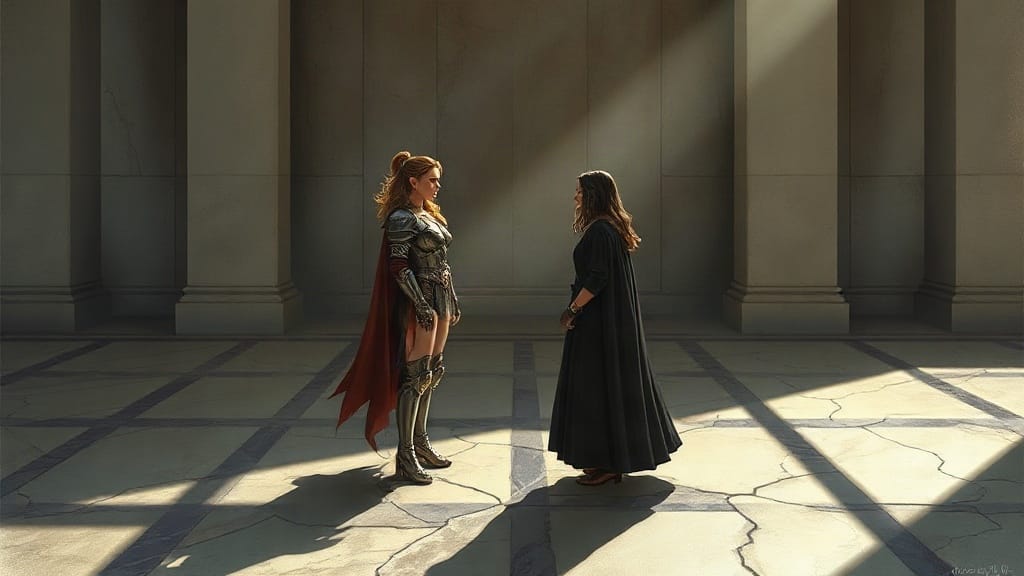
Traditional event structure treats villains as function: they create the problem the hero must solve. Their psychology, when it appears at all, tends to arrive in exposition — a monologue that explains motive just before defeat. The Matriarch annual inverts that hierarchy. It insists that understanding the antagonist is not supplementary to understanding the event. It is the event, or at least half of it. That structural inversion changes how a reader experiences the main title. When you know what Matriarch wants and why she wants it with the granularity that 48 pages of character-focused storytelling can provide, Diana's choices in #37 and beyond carry a different moral weight. The conflict stops being a clash between good and evil and becomes something harder to resolve cleanly: a clash between two sets of convictions, both of which have been given room to breathe.
Stephanie Williams and What the Nomination Means
Co-writing that annual is Stephanie Phillips Williams, who earlier this year became the first Black woman nominated in the Eisner Award's Best Writer category — one of the most structurally conservative recognitions in comics criticism, historically resistant to acknowledging writers outside a narrow tradition. The nomination itself is data. It confirms what readers who followed her work on Nubia: Queen of the Amazons (2022) and Harley Quinn (2021) already understood: Williams writes antagonists and secondary characters with an interiority that most writers reserve for protagonists. Her co-authorship of the Matriarch annual is not a marketing decision dressed up as editorial boldness. It is a casting decision, in the truest sense — the right writer assigned to the right problem.
Leah Williams, whose own work on X-Factor (2020) demonstrated an unusual capacity for managing ensemble casts without flattening any individual voice, brings a complementary set of tools. Together, they are not simply expanding the event's page count. They are expanding its moral vocabulary. What Matriarch believes, and what she has suffered to arrive at those beliefs, will be rendered with the same craft the main title applies to Diana. That parity of craft is the argument DC is making.
The Quiet Restructuring
Step back from the individual titles and a pattern becomes visible. DC has been, with less fanfare than such decisions typically attract, redistributing where meaning lives in its event storytelling. The crossover model assumes that meaning scales with breadth — the more titles involved, the more important the story must be. The companion-annual model assumes the opposite: that meaning scales with depth, that a story becomes more important the further inward it is willing to go.
This is not a repudiation of event comics as a format. It is a refinement of what event comics can accomplish when the publisher is willing to resist the impulse to maximize real estate. "The Wonder War" is not touching every corner of the DC line. It is not asking readers to track a reading order across eight titles. It is asking them to sit with two women — one mythological, one ideological — and understand both well enough that the war between them registers as tragedy rather than spectacle.
That ambition has precedent in the medium, though rarely in the superhero mainstream. The closest analogues tend to be found in longer-form literary comics, where the luxury of space has always been available. What King, Sampere, and the Williams writers are attempting is to import that luxury into a format that has historically treated compression as the default mode and depth as a bonus feature unlocked only in collected editions.
What to Watch For
The test of this structure will be legibility on both sides of the September 30 divide. Does Wonder Woman #37 hold as a complete reading experience for someone who has not yet encountered the Matriarch annual? And does the annual function as more than annotation for someone who has? If both answers are yes, DC will have demonstrated something genuinely useful: that event storytelling can be built on parallel tracks of interiority without requiring readers to choose between them or to consume them in strict sequence.
King's track record suggests the main title will be engineered to sustain that independence — his scripts tend to encode enough emotional context that they function even without supplementary reading. The annual is likely to function differently: less as prerequisite, more as revelation. Something that changes the color of what you already read rather than filling in information you were missing.
That is, when it works, one of the more satisfying things a companion publication can do. Not explain. Recontextualize.
"The Wonder War Act 2" is a large story being told small, on purpose, by people who understand the difference. In a publishing landscape still largely committed to scale as a proxy for significance, that constitutes a genuine editorial position. Whether it finds the readership that position deserves is the only question left open.