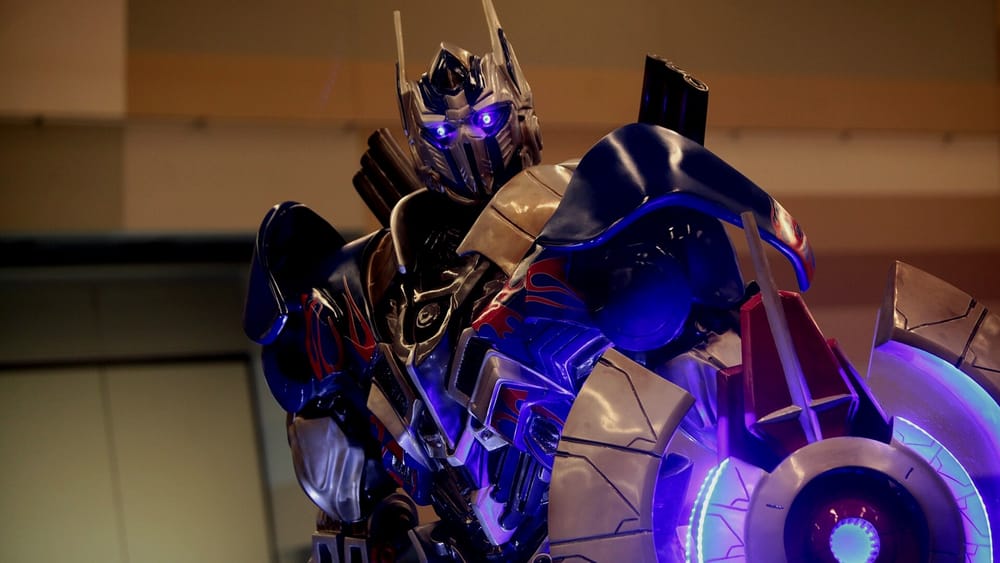
On September 17, 2026, The Transformers: The Movie (1986) returned to cinemas in 4K, with premium 4DX presentations in selected markets, forty years after it opened and closed with barely anyone noticing. Hasbro has given the campaign a name. It is calling it The Apology Tour.
The joke is aimed at a specific wound. In the film's first act, Optimus Prime — the Autobot commander, the moral centre of the entire property, the character whose voice had been the sound of decency in a toy commercial since 1984 — takes a wound to the chest and dies on a medical slab in front of an audience of children who had absolutely no preparation for it. The apology is for that. Four decades later, the company is selling tickets on the strength of the trauma it deliberately inflicted, and packaging the gesture with a new post-credits scene, a reformatted soundtrack, a deluxe hardcover collection, and a fresh line of collectibles.
It would be easy to file this as cynicism, and cynicism is certainly present. But the campaign accidentally identifies something true and uncomfortable about this franchise, which is worth stating plainly at the outset: the single best creative decision in forty years of Transformers cinema is the one the rights holder has spent forty years apologising for. Everything after 1986 — nine further theatrical features, more than $5 billion in worldwide box office, four distinct tonal reboots — has been an elaborate, expensive argument about whether that decision should ever be repeated. The answer, so far, has been no.
August 1986: A Toy Commercial That Accidentally Committed
The production facts are unglamorous and they explain almost everything. The Transformers: The Movie was directed by Nelson Shin, written by Ron Friedman, animated as a co-production between Sunbow Productions, Marvel Productions and Toei Animation, and distributed in North America by the De Laurentiis Entertainment Group. Its budget was roughly $6 million. It grossed about $5.9 million domestically. It finished as the ninety-ninth highest-grossing film of 1986. Hasbro reportedly lost around $10 million across two De Laurentiis collaborations that year, of which this was one.
The film exists for one reason: Hasbro needed to clear inventory. The 1984–85 toy line had saturated. A new assortment was coming, and the animated feature was designed as the mechanism by which the old characters would be removed from the fiction so that retailers could stop stocking them. This is not a fan theory or a retrospective inference. It was the brief. Characters would die because the moulds were being retired.
Friedman, the screenwriter, objected to killing Optimus Prime specifically. He warned that it would not work — meaning, presumably, that it would not work commercially, that audiences would reject it. He was overruled. What followed is the most consequential miscalculation in the franchise's history, because the decision worked far too well. Children did not shrug and buy Rodimus Prime. They were devastated. The letters arrived. The stories accumulated: kids leaving the cinema mid-film, kids refusing to discuss it, one much-repeated account of a child who locked himself in his bedroom for two weeks. Hasbro would eventually resurrect the character on television, which is the clearest possible admission that the original gambit had misfired.
But here is the thing about a miscalculation of that magnitude: it requires the work to have landed. You cannot traumatise an audience with a scene they did not believe. The 1986 film, for all its status as a merchandising instrument, is directed with genuine conviction — Vince DiCola's synthesizer score treats the material as opera, the colour palette is aggressive to the point of hallucination, and the death scene is staged with a slowness that a cynical production would never have allowed. Stan Bush's "The Touch," a song originally written for Sylvester Stallone's Cobra and repurposed here, became the franchise's permanent emotional shorthand; it would resurface, knowingly, in Bumblebee thirty-two years later. "Weird Al" Yankovic contributed "Dare to Be Stupid" to a scene of anarchic junk-planet nonsense. None of this is the behaviour of people phoning in a commercial.
The Film Underneath the Commercial
It is worth pausing on craft, because the received wisdom — that the 1986 film is beloved for nostalgic reasons and no others — does not survive a rewatch.
Start with the opening. Most children's features of the period established their world through exposition delivered by a friendly narrator. This one opens on Unicron consuming a populated planet, in silence broken only by DiCola's synthesizers, and kills every character we have just met. It is a four-minute sequence whose entire function is to establish that the film will not protect anyone. By the time Optimus Prime dies forty minutes later, the grammar has been taught. The audience simply refused to believe the lesson applied to him.
The animation, produced across Toei Animation in Japan and supporting studios in South Korea, is wildly inconsistent — and the inconsistency is part of why it reads as a film rather than an extended episode. Television Transformers was animated to a fixed, cheap, legible standard. The feature breaks that standard constantly: smear frames, hand-drawn lens flares, camera moves that no television budget would have permitted, character models that shift weight between shots. It looks like a production straining at its own ceiling, which is a more interesting thing to watch than a production comfortably inside one.
The design language is the other break. Television Transformers were boxy, primary-coloured, and readable at low resolution because they had to sell as plastic. The film's new characters — Hot Rod, Kup, Galvatron, the Quintessons, and above all Unicron — are drawn with a complexity that assumes a cinema screen. Unicron's transformation from planet to humanoid is still, four decades on, one of the best-staged scale reveals in animated science fiction: the film holds on the geometry long enough for the audience to do the arithmetic themselves.
And then there is the score, which is the element that has aged least. Vince DiCola's work is pure 1986 — layered synthesizers, driving arpeggios, no orchestra anywhere near it — and it commits absolutely to treating a robot war as tragedy. Paired with a needle-drop soundtrack of rock and metal cuts, it produces something almost no children's film of the era attempted: a sustained emotional register that does not modulate downward to reassure anyone. The soundtrack has outlived most of the films that came after it, and it is being reissued as part of this anniversary for a reason.
Orson Welles, Who Despised It, and Gave It Its Gravity
The casting sheet remains startling. Leonard Nimoy voiced Galvatron. Judd Nelson, at the peak of his Brat Pack visibility, voiced Hot Rod and his ascended form, Rodimus Prime. Eric Idle voiced Wreck-Gar. Robert Stack voiced Ultra Magnus. Peter Cullen returned as Optimus Prime, a role he has now held, with interruptions, for more than four decades.
And Unicron — a planet-sized machine that eats worlds, the closest thing this franchise has to a cosmology — was voiced by Orson Welles, in what became his final screen credit. He recorded the part in the autumn of 1985, days before his death on 10 October that year. The film opened ten months later, posthumously.
Welles was contemptuous of the job. His biographer Barbara Leaming recorded him describing it as playing "a toy" — some robot that changes from one thing into another, a planet whose scheme fails. He was frail; his voice had thinned; the production processed it through a synthesizer and sped it up by roughly eight percent to restore some of its old authority.
The result is the most interesting artistic accident in the franchise. A man who regarded the assignment as beneath contempt delivered a performance that gives a children's toy commercial a genuine sense of cosmic dread — and the reason it works is precisely that Welles is not condescending to it. He is simply using the instrument he had. That gap between intent and effect is the 1986 film in miniature: a piece of commercial hardware that keeps producing art it was not commissioned to produce.
Why It Failed, and Why It Outlived Everything Around It
Contemporary critics were unambiguous. The New York Times noted the animation was not spectacular enough to hold adults. Leonard Maltin dismissed it as little more than an obnoxious, feature-length toy commercial. This was, on the available evidence, a reasonable reading in 1986. Nothing about the release positioned it as anything else.
The reappraisal came through a mechanism that is now familiar but was novel then: home video, repetition, and generational handover. The film has grossed roughly $29.4 million in domestic DVD and Blu-ray sales across decades of reissues — five times its theatrical gross, accumulated slowly by an audience that kept returning to it. Its critical standing has drifted upward accordingly; it currently sits at 62% on Rotten Tomatoes, which is not a rave, but is a remarkable recovery for a film that was treated as a commercial artefact on arrival.
The pattern is not unique to Transformers. It is the same curve traced by Castlevania across its own fortieth anniversary — a property whose founding text was undervalued in its moment and then canonised by the people who grew up inside it. What distinguishes Transformers is the severity of the gap. Most reappraised works were merely misjudged. This one was correctly judged as a toy commercial and turned out to be a toy commercial with a real film inside it.
Twenty-One Years of Nothing, Then Michael Bay
The franchise did not return to cinemas until 2007. That gap — twenty-one years — is the most underdiscussed fact in its history. A property with global brand recognition and an established feature precedent simply had no theatrical presence for two decades, sustained entirely by television, toys and comics.
What is easy to miss is that the property did not stagnate during those twenty-one years. It mutated, repeatedly, on television — and television is where it kept taking the risks the films would not. Beast Wars (1996) abandoned vehicles for animals, adopted full computer animation years before that was a safe choice for a children's series, and built a serialised narrative with permanent deaths and real moral ambiguity. Transformers: Prime (2010) reintroduced weight and consequence for a generation raised on the live-action films. The Netflix War for Cybertron trilogy pushed the fiction toward outright bleakness.
That distinction matters to the argument. The claim is not that Transformers is incapable of seriousness. It is that the theatrical arm — the most expensive, most visible, most commercially exposed arm — has been the most conservative one for four decades running. The risks kept being taken where less money was at stake.
What ended the theatrical drought was Michael Bay, and what Bay understood was that the 1986 lesson had been filed incorrectly. Hasbro had concluded that audiences would not accept losing characters. Bay concluded something adjacent and more commercially durable: that audiences did not need to be attached to the characters at all. The live-action series that followed treated the robots as spectacle delivery systems, scaled the human plot to the requirements of military hardware, and made the Autobots functionally immortal.
It worked, enormously, and then it stopped working:
Transformers (2007) — $319.2 million domestic, $709.7 million worldwide.
Revenge of the Fallen (2009) — $402.1 million domestic, $836.3 million worldwide.
Dark of the Moon (2011) — $352.3 million domestic, $1.12 billion worldwide.
Age of Extinction (2014) — $245.4 million domestic, $1.10 billion worldwide.
The Last Knight (2017) — $130.1 million domestic, $605.4 million worldwide.
Read the domestic column alone and the story is unmistakable. The North American audience began leaving after the second film and never came back; the global total was propped up for two further entries by international markets, principally China, before that support gave way too. By The Last Knight, the series had lost roughly two thirds of its domestic audience from the peak while continuing to spend at blockbuster scale.
The diagnosis usually offered is fatigue, and fatigue is real. But fatigue does not explain why the collapse was so much steeper domestically than globally, or why it began so early. A more precise reading is that Bay's model had no renewable resource. The 1986 film generated its power from consequence: something was lost and stayed lost. The live-action films generated theirs from escalation, and escalation is a currency that devalues with every transaction. There is no third act available to a franchise in which nothing can be destroyed that matters.
In Defence of Bay, Briefly
It has become reflexive to treat the live-action films as artless, and that reflex is lazy enough to be worth interrupting.
The first Transformers solved a genuinely hard technical problem. Before 2007, nobody had convincingly rendered a photoreal mechanical figure with thousands of independently articulated parts moving through daylight and interacting with practical vehicles and real actors. Industrial Light & Magic's work on that film is a genuine watershed — the transformation sequences alone required a design philosophy in which every visible panel had a destination. Whatever one thinks of the results, the craft ceiling of mainstream visual effects moved because of it.
Bay's formal grammar — low, roaming camera; anamorphic flares; constant lateral movement; heroes framed from below against a low sun — is genuinely distinctive and genuinely imitated, which is the working definition of a style. The problem was never that he had no ideas. It is that his ideas are all in the register of magnitude, and magnitude cannot carry a fifth instalment. Watch the 2007 film's introduction of Bumblebee and then the equivalent scene in The Last Knight: the technique is more accomplished the second time and means nothing, because there is no longer anything at stake underneath it.
That is not an indictment of a director. It is an indictment of a model — one in which the fiction was engineered so that nothing could ever be lost, which is precisely the correction Hasbro made after 1986.
The Corrections That Worked — and the Audience That Did Not Come
What happened next is the cruellest sequence in modern franchise cinema, and it deserves to be stated without softening: each time the Transformers films got better, they earned less.
Bumblebee (2018), directed by Travis Knight, was the deliberate corrective — smaller, warmer, set in 1987, built on a single relationship rather than a war, and openly nostalgic for the G1 designs the Bay films had discarded. Critics broadly welcomed it as the best live-action entry by a distance. It grossed $127.1 million domestically and $467.9 million worldwide, the lowest of the live-action series to that point.
Rise of the Beasts (2023) attempted to split the difference between Knight's intimacy and Bay's scale, and finished at roughly $439 million worldwide — lower still.
And then Transformers One (2024), the animated origin story of Orion Pax and D-16 before they became Optimus Prime and Megatron, arrived carrying an A CinemaScore, an audience score in the high nineties, and the best reviews the franchise had received since the reappraisal of the 1986 film. Against a $75 million budget it opened to $25 million domestically and finished at approximately $124 million worldwide. Its director has since indicated that Paramount is not pursuing a sequel.
Consider what that sequence establishes. The franchise made a version of itself that was well-reviewed, well-liked, comparatively cheap, and thematically serious — a film explicitly about how a friendship becomes a war — and the market declined to reward it. This is the same structural problem visible across the studio landscape right now, from Lionsgate's decision to put the Hunger Games back into cinemas as an audience-rebuilding exercise to the broader collapse in mid-budget theatrical returns. Quality has stopped functioning as a reliable input.
What the Apology Tour Is Actually Admitting
Which brings us back to a cinema foyer in September 2026, and a marketing campaign that says sorry.
The 2026 re-release is not a straightforward restoration. It arrives with an all-new post-credits scene attached to a forty-year-old film, and with the world premiere of Optimus Prime: Awakening, an original CG-animated short, playing with every screening. Hasbro has bracketed the run with a wider Transformers Day celebration, including a tribute to Peter Cullen, whose voice is now the longest continuous piece of continuity the property has. At CinemaCon in April 2026, Paramount executives confirmed that a new Transformers film is in development, without naming a director, a format, or a date.
So the apology is doing two jobs at once. It acknowledges, correctly, that the 1986 death is the franchise's most remembered moment. And it converts that acknowledgement into a product line — soundtrack reissue, hardcover collection, visual history, collectibles, a short film, a new scene grafted onto the old one.
There is a version of this that is simply good business, and it is worth being fair about that. Anniversaries are how legacy properties stay solvent between films, and a 4K restoration with a new short attached is a considerably better offer than most. The 4DX presentation is a genuine novelty for a hand-drawn 1986 feature. Fans who have waited forty years for the film to be treated as a film rather than an embarrassment are getting something real.
But the framing gives the game away. To apologise for Optimus Prime's death is to classify it as a mistake — a customer service failure requiring remediation — when it is in fact the only moment in this entire filmography that anyone has been unable to forget. Nobody is running an apology tour for The Last Knight. Nobody needed closure after Age of Extinction. The franchise's commercial apparatus has spent four decades protecting audiences from the one thing that proved it could produce something more than spectacle.
Forty Years, One Idea
Every long-running property eventually faces the question of what it is actually for. Star Trek answered it by becoming a template for fandom itself. Resident Evil is currently answering it by handing the keys to a horror auteur. Transformers has answered it, repeatedly, by expanding scale and deferring consequence — and the returns on that answer have been falling for fifteen years.
The 1986 film is not a great film by conventional measure. Its animation is uneven, its plot is a corridor of set pieces, its dialogue frequently exists to introduce a product. What it has, and what nothing since has matched, is a willingness to take something away from the audience and not give it back. It was made for the wrong reasons by people who did not fully intend the result, and it remains the only entry in this franchise that a general audience can describe from memory.
Forty years on, the company that built it is selling tickets to it with a note of contrition attached. The more honest version of the campaign would not be an apology. It would be a question: what would it cost, now, to make a Transformers film that risked as much as the one made by accident in 1986 — and is there still an audience willing to pay for it?
On the evidence of Transformers One, the second half of that question is the harder one.