Sony didn't announce the death of physical gaming. It just quietly started building the coffin. With the PlayStation 5 Digital Edition becoming the default retail push, disc-free bundles flooding shelves, and a licensing structure that increasingly treats game ownership as a subscription to be revoked, the writing isn't on the wall — it's already been painted over.
The Economic Architecture of Disappearance
The numbers frame the argument clearly. The global physical video game market was valued at over $33 billion in 2022. By 2028, analysts project digital sales will account for more than 85% of all game revenue. Sony's strategy isn't accidental — it's a deliberate migration of economic power from the consumer to the platform holder.
When you buy a physical game, you own an asset. You can resell it, lend it, trade it, or simply keep it as a functional object decades from now. A disc of God of War: Ragnarök (2022) purchased today will still run on compatible hardware in 2040, regardless of whether Sony's servers are alive, whether the game has been delisted, or whether the company itself still exists in its current form. A digital license offers none of those guarantees. It is, legally and practically, a revocable permission slip.
The secondary market — GameStop's ghost, CEX, eBay listings, local game shops — moves billions of dollars annually through physical resale. That money circulates between players. It subsidizes the next purchase, lowers the barrier of entry for younger or lower-income audiences, and creates an ecosystem where gaming is economically accessible without requiring a perpetual subscription to someone else's infrastructure. Eliminating physical media doesn't just kill that market. It redirects all of that economic flow directly into platform holders' revenue streams.

Platform Lock-In Is the Product
Digital-only ecosystems are, by design, closed loops. Once a player's library exists exclusively on PSN, the cost of switching platforms becomes catastrophic — not in hardware price, but in sunk costs. Every digital purchase is a brick in the wall that keeps players inside Sony's garden. This is not an incidental side effect of digital convenience. It is the strategic objective.
Sony has already demonstrated the fragility of digital permanence. In 2021, the company announced — and later partially reversed — plans to shut down the PlayStation 3, PSP, and PlayStation Vita storefronts, which would have rendered hundreds of purchased titles permanently inaccessible. The reversal came only after severe public backlash. The intention, however, was already visible. Digital libraries are maintained at the discretion of the corporation, not the consumer.
The pricing structure reinforces the asymmetry. New physical releases and their digital counterparts are often priced identically at launch — but physical copies depreciate on the secondary market within weeks, while digital prices remain artificially static, discounted only when the platform holder decides. The consumer loses the depreciation benefit while the platform captures the margin difference. It is a structural transfer of value, framed as modernization.
The Emotional Weight of a Cartridge
Beyond economics, the disappearance of physical media carries a cultural loss that resists easy quantification. A game on a shelf is a biographical artifact. Collectors, preservationists, and ordinary players invest emotional meaning in physical objects in ways that a digital library thumbnail cannot replicate. The texture of a manual, the weight of a case, the specific wear on a cartridge — these are not nostalgic irrelevancies. They are the material evidence of a relationship between a person and a piece of culture.
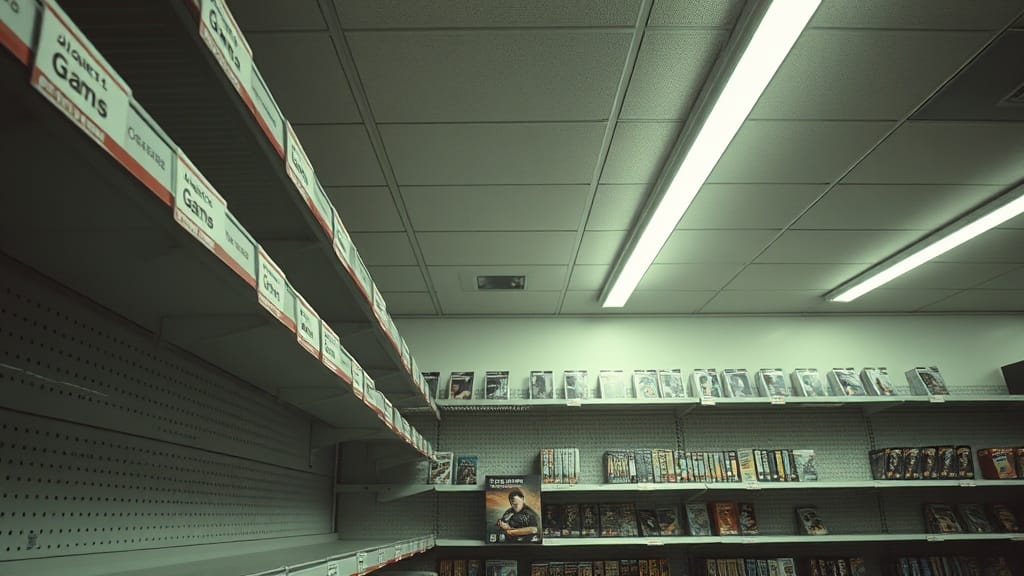
Video game preservation is already in crisis. The Video Game History Foundation estimated in 2023 that 87% of classic games are out of print and essentially inaccessible through legal means. Physical media is the primary reason any of that history survives at all. Emulation exists because cartridges and discs existed first. Remove the physical substrate and you remove the preservation vector. What remains is whatever Sony, Microsoft, or Nintendo decides deserves to stay alive — curated history, not actual history.
What the Resistance Looks Like
The market has not gone quietly. Limited Run Games has built an entire business model around producing physical editions of otherwise digital-only titles, with pre-orders regularly selling out. The vinyl revival proved that physical formats don't die when they're better — they die when the industry stops supporting them. Players have shown, repeatedly, that they will pay a premium for ownership when ownership is genuinely on offer.
Legislative pressure is also building. The European Union's Digital Markets Act and ongoing consumer rights debates in the US are beginning to interrogate what "purchasing" a digital product actually means in legal terms. The outcome of those arguments will shape the next decade of gaming more decisively than any hardware launch.
Sony's pivot toward digital exclusivity is coherent from a shareholder perspective and corrosive from a consumer one. It concentrates economic power, eliminates the secondary market, locks players into proprietary ecosystems, and accelerates the erosion of gaming's cultural record. The disc isn't just a format. It's a property right. And property rights, once surrendered, are rarely returned.