The premise of Alien vs. X-Men (2026) sounds, on paper, like the product of a licensing meeting rather than a creative one. Two marquee properties, one miniseries, move units. Marvel has been here before — with varying degrees of artistic ambition — and readers who have lived through the IP-collision era of superhero comics have every right to approach such a thing with their guard up. Issue two, released on October 28, 2026, argues that their guard should come down.
What writer Kieron Gillen and artist Geraldo Borges have constructed in this four-issue limited series is not a crossover in the comfortable, consequence-free sense. It is, as Gillen has been explicit about in interviews, an Alien story first and an X-Men story second — the mutants are not the genre's protagonists so much as its victims. Issue two makes that tonal wager pay off, accumulating a body count and a twist ending that reframe the entire limited series as something darker than the cover art promises.
The Setup and What the Second Issue Inherits
Alien vs. X-Men #1 launched on September 30, 2026, establishing that the X-Men returned to Earth carrying Xenomorphs after searching for a Phoenix egg — a clean, economical premise that puts the horror machinery in motion without overcomplicating the entry point. The series is a four-issue run, with its final issue solicited for December 30, 2026, meaning Gillen has almost no room for structural indulgence. Every issue has to do work.
Issue two opens by expanding on Beast's video transmission — a device borrowed from the cold economy of Ridley Scott's original Alien (1979), where information arrives too late to help anyone. Beast's log explains how the X-Men were taken down by the Xenomorphs and what the creatures are capable of, and rather than functioning as pure exposition, it reads as a mechanism for establishing dread. The team that went into space is effectively gone. Storm, Charles Xavier, Gambit, Rogue, and Jubilee are what remains on Earth, and the threat they face has already absorbed some of the most formidable mutant power sets in the Marvel catalogue.
That last point is where the series' central conceptual gambit becomes genuinely frightening. Xenomorphs capable of mimicking the abilities of Wolverine, Emma Frost, and even the Multiple Man are not the same threat as a standard Xenomorph infestation. A Xenomorph that can replicate Jamie Madrox's self-duplication is not an organism you can contain with a bulkhead. The math of survival changes completely, and Gillen has clearly thought hard about what it means to drop these two specific franchises into the same room.
Cable as Structural Device
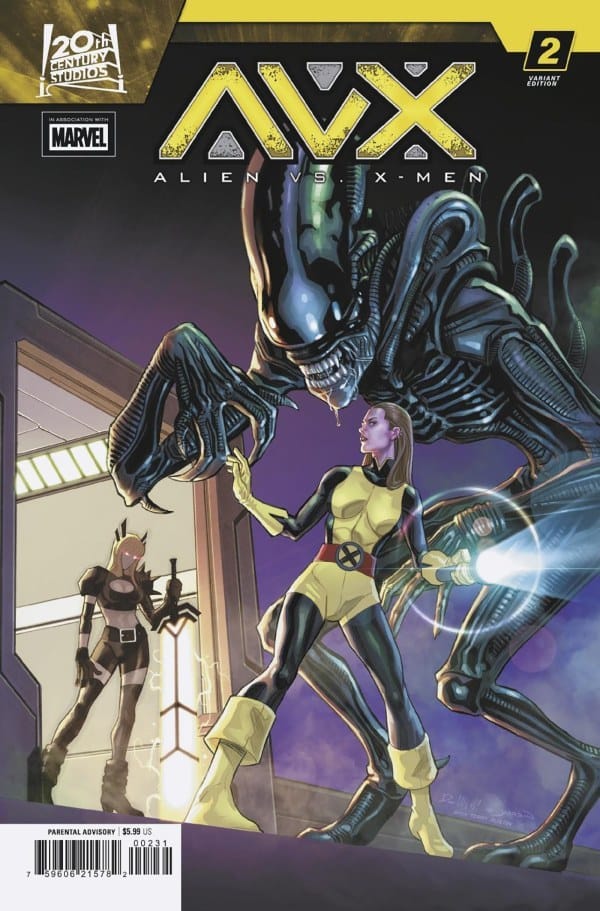
The issue's centrepiece arrival — Cable, leading a handpicked strike force from the future — is the kind of move that could easily tip into self-parody. Time-travelling cavalry charging in to explain the stakes is a formula with a long and frequently exhausting Marvel history. Gillen flagged the intention in advance: wanting to use Cable was the main reason he included Hope in the present-day portion of the story, and he was explicit that Alien's preoccupation with parenthood was the thematic echo he was after. Cable's arrival is not a rescue — it is a complication. He comes from a future that already knows how badly this goes, and the information he carries makes things worse rather than better.
The comic hits the familiar formula of Cable explaining what the future looks like and why his team has come back, but Gillen buries grisly specifics in that framework that justify the structure. The issue is interested less in the mechanics of time travel than in what it means that someone had to come back at all — and what it says about the X-Men's odds that even knowing how things turn out, the future apparently sent help anyway.
The final page delivers a twist that multiple outlets describe as genuinely unexpected, adding what AIPT calls "shades of another big James Cameron movie" to the mix — a second Cameron franchise bleeding into the crossover's DNA without being named outright, sharpening the series' already considerable stakes. The new Alien Queen, meanwhile, makes a visual impression that Nerd Initiative reviewer Matt Roth credits specifically to Andrew Dalhouse's colours, noting the way the Queen's visual replication of Emma Frost's aesthetic makes her seem "almost majestic." That's not an accident. Dalhouse's colour work transforms the Queen Xenomorph replicating Emma Frost's character into something that reads as genuinely regal, which is arguably more unsettling than straight horror.
Where the Critical Consensus Lands — and Where It Doesn't
The reviews that dropped on October 28 — the day of release — represent a reasonable cross-section of critical response, and they are largely but not unanimously positive. AIPT finds the second issue even stronger than the first, calling the twist "truly shocking." Graphic Policy calls it "a fantastic second issue that packs a punch and has no problem upping the body count" while acknowledging the formulaic bones underneath. Nerd Initiative rates it 8.5/10 and praises the claustrophobia that the art team maintains across its pages.
The most measured dissent comes from Comic Watch, which notes that the issue is mostly dialogue, making page turns slower, with most panel transitions dramatic without much kinetic oomph outside occasional gruesome cut-aways. That is a fair observation. Issue two is not an action issue; it is an information and dread issue, building pressure rather than releasing it. Whether that represents a pacing problem or disciplined structural construction depends entirely on how much faith the reader is extending to a four-issue finale that hasn't arrived yet. At this point, the series has earned enough goodwill to warrant the benefit of the doubt.
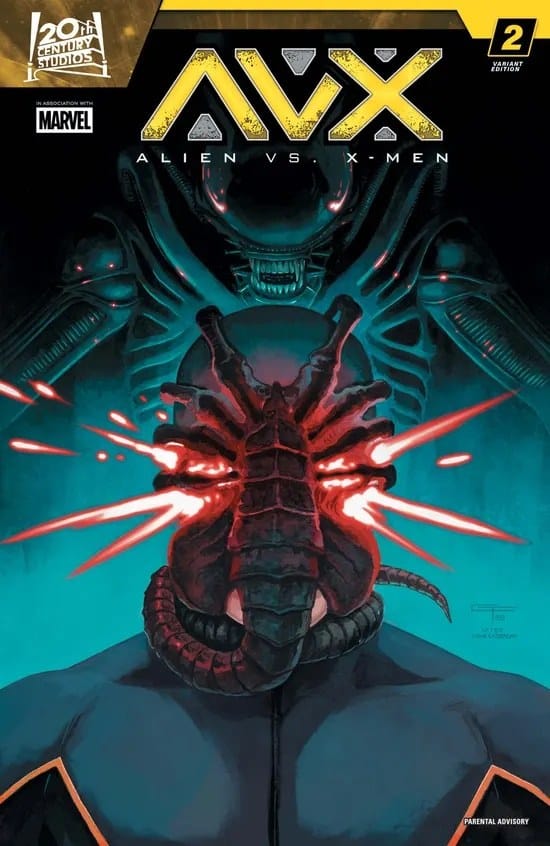
What no reviewer disputes is that the horror mechanics are working. Chestbursters and Facehuggers appear without the book lingering gratuitously on the gore — the restraint is intentional and effective, because the issue understands that dread is more durable than spectacle. Even Wolverine, degraded by Xenomorph acid, is rendered with a kind of grim matter-of-factness that underscores just how irrelevant his regeneration factor has become in this context.
The Longer Context: Marvel's Alien Line and What It Has to Justify
Alien vs. X-Men inherits directly from Aliens vs. Avengers (2024–2025), the Jonathan Hickman and Esad Ribić four-issue series that launched Marvel's Alien crossover ambitions with a future-set, tonally bleak story of Earth abandoned to the Xenomorph infestation. That series set a high bar for how seriously this IP could be handled when paired with genuine creative investment. Gillen's task is different: Hickman could build a sprawling future canvas, whereas a four-issue story set in the present requires more surgical choices about what to sacrifice and what to protect.
Gillen's answer, evident across both issues, is to sacrifice the heroes. He has stated plainly that this is the X-Men wandering into an Alien story, not the Alien franchise visiting an X-Men story — the "level of luck the X-Men have in their own universe is not true here." That tonal commitment is what separates this from the long history of Marvel event comics in which the stakes feel provisional and the body count reversible. The series also features backup material from Chris Claremont with art by David Messina, focusing on Kitty Pryde and Ilyana Rasputin — a pairing that leans into Claremont's own history with parasitic alien body horror through the Brood, though the backup is more a fan-service gesture than an essential counterpart to the main story.
The series' structural constraints are also worth acknowledging openly. At four issues, Alien vs. X-Men has no fat to carry. Issue three, solicited for November 25, brings Sentinels into the conflict — a development that, on paper, risks overcrowding an already busy premise. But so far, Gillen has shown enough control over the material to suggest that complication will be purposeful rather than escalation for its own sake. This is, after all, the writer whose Krakoan-era X-Men work — now collected and reassessed — demonstrated a consistent appetite for deploying genre machinery against the emotional architecture of the characters rather than around it. For more on that body of work, see our analysis of the Kieron Gillen X-Men omnibus and the broader landscape of what Marvel's current event publishing is doing in Avengers: Armageddon #5.
Two issues in, Alien vs. X-Men has done the hardest thing a licensed crossover can do: it has made the premise feel necessary. The Xenomorphs are not decoration here. They are the point. And right now, that's enough.