Ted Lasso was never supposed to exist. In 2013, NBC Universal needed to sell American audiences on its newly acquired Premier League broadcast rights, so it commissioned a short promotional sketch — two minutes, SNL cadence, broad accent, a fish-out-of-water premise so thin it could have dissolved in a light drizzle. A bumbling American football coach transplanted to English soccer. Laugh track implied. Cultural footnote expected. That was the plan, and it was a modest one.
What happened instead is one of the stranger origin stories in recent television history. Jason Sudeikis held onto that character for seven years. When Apple TV+ greenlit a full series in 2020 — the precise, catastrophic center of a global pandemic — Ted Lasso (Ted Lasso, 2020) arrived not as comfort food but as something more unsettling: a sustained argument that decency is a discipline. It won 13 Emmy Awards. It made people cry on airplanes. It was, for a specific and disorienting moment, the most talked-about show on television.
And then, at the end of Season 3, it said goodbye.
The Finale That Closed the Door
The Season 3 finale was constructed with the deliberateness of a period at the end of a sentence. Ted Lasso returned to Kansas. AFC Richmond's arcs — Keeley's agency, Rebecca's reckoning with her own ambitions, Roy Kent's evolution from scowl to something approaching self-awareness — were drawn to conclusions that felt, if not tidy, then at least intentional. The show's creators spoke in terms of completion. Sudeikis called it the end of a chapter. Bill Lawrence, the showrunner who had shepherded the series through its entire run, confirmed he was stepping back from day-to-day operations for a potential continuation.
By any conventional reading, the door was shut. Which makes what happened in March 2025 either a creative betrayal or a creative dare, depending on how seriously you take the distinction between a finale and a full stop.

The Return, Restructured
Season 4 was confirmed in March 2025. Cameras rolled from July of that year. What leaked from production, and what has since been confirmed, suggests the writers understood that returning to the same pitch — Ted coaches AFC Richmond's men's first team through another Premier League season — would be exactly the kind of nostalgic self-cannibalization the show's entire ethos argued against.
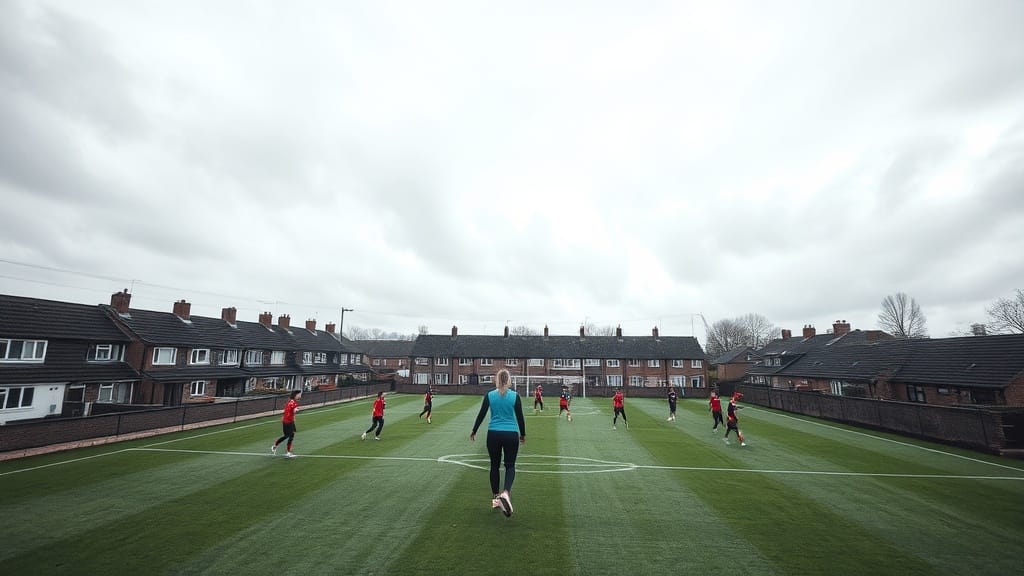
Instead, the structural shift is the story. Ted comes back to manage a newly formed women's second-division side operating under the AFC Richmond umbrella. It is a different league, a different set of stakes, a different political and institutional terrain. Women's football in England exists inside a genuinely complex ecosystem — underfunded, underseen, fighting for legitimacy inside organizations that have historically treated it as an afterthought. Dropping Ted Lasso into that environment isn't a gimmick. It's a pressure test of whether his particular brand of belief-as-methodology holds in a context where the obstacles aren't rival clubs and ego but structural indifference.
Lawrence stepping back as showrunner is not a minor footnote. He built the architecture of this show — its rhythm, its habit of earned sentiment, its refusal to mistake irony for intelligence. His absence from the center chair means Season 4 is, in a real sense, a new production wearing a familiar jersey. Whether the writers' room can preserve the show's internal logic without him is the genuine dramatic tension surrounding this season, and it exists entirely off-screen.
Who Returns, Who Doesn't
Sudeikis is back. Hannah Waddingham, Juno Temple, Brett Goldstein, Jeremy Swift, and Sarah Niles return. The connective tissue of the ensemble — the relationships that took three seasons to build — remains largely intact. Brendan Hunt, who plays Coach Beard and who co-created the series alongside Sudeikis and Lawrence, also returns, which matters more than it might appear: Beard is the show's institutional memory, its deadpan conscience.
Phil Dunster is absent. Jamie Tartt's arc across three seasons was one of the show's most carefully constructed — a portrait of narcissism as self-protection, gradually dismantled. His absence from Season 4 is either a narrative decision that respects where that character landed or a logistical reality dressed up as one. Possibly both.
The additions carry intent. Tanya Reynolds, whose work in Sex Education (Sex Education, 2019) demonstrated a precise ability to play social alienation without self-pity, joins the cast. Faye Marsay, a quiet and underutilized presence in British television for years, comes aboard as well. Both suggest a writers' room interested in texture rather than star power — in building a new ensemble around the returning core rather than importing recognizable faces to fill the space Jamie Tartt leaves behind.
Kindness in 2026 Is a Different Proposition
When Ted Lasso premiered, optimism on television was already unfashionable. The dominant aesthetic was prestige darkness — antiheroes, moral ambiguity worn as sophistication, the assumption that to be cynical was to be serious. Ted Lasso pushed back against that not by being naive but by being precise: it understood what cynicism actually costs, and it chose to dramatize that cost rather than romanticize the alternative.
In 2020, that choice read as refreshing. In 2026, it reads as defiant.
The television landscape that Season 4 returns to is one in which algorithmic anxiety has further collapsed the space for slowness, for patience, for the kind of storytelling that trusts its audience to sit with discomfort before resolution. The culture-wide exhaustion with sincerity — the reflex to preemptively mock anything that asks to be taken seriously — has not softened. If anything, the ironic defensive crouch has become the default posture of public discourse, online and off.
Choosing to make a show about a man who genuinely believes in people, in a moment when belief of any kind is treated as either a commodity or a vulnerability, is not a soft choice. It is a hard one. The counterculture move in 2026 is not nihilism — nihilism is the establishment. The counterculture move is to insist, without apology and without sentimentality, that how you treat people is a philosophy worth defending.
Ted Lasso didn't start as a statement. It started as a promo sketch for Premier League broadcasting rights. What it became — and what Season 4, against considerable odds and reasonable skepticism, has the chance to reaffirm — is the argument that optimism is not the absence of awareness. It is what you build in spite of it.
The counterculture move in 2026 is not nihilism — nihilism is the establishment. The counterculture move is to insist, without apology and without sentimentality, that how you treat people is a philosophy worth defending.
That's a harder case to make now than it was four years ago. Which is precisely why it's worth making.
 Official trailer