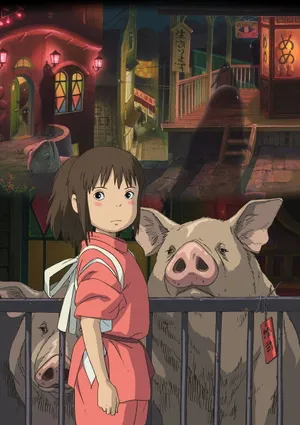
Every Hayao Miyazaki film ends the same way, structurally if not literally: something is lost, and the loss is not reversed. Chihiro leaves the spirit world and will eventually forget it. The castle in Howl's Moving Castle (2004) survives, but not in the form it began. Even My Neighbor Totoro (1988), the gentlest thing he has made, is built around a mother's illness that the film never pretends to cure. Miyazaki is routinely described, especially outside Japan, as a maker of whimsical, comforting family entertainment — a reputation built on marketing stills of soot sprites and flying castles rather than on what his films actually argue. What they argue, with a consistency that spans five decades, is that impermanence is not a tragedy to be resolved but the basic condition under which anything worth protecting has to be protected. That is a harder, stranger idea than "whimsy," and it is the reason his work has outlasted several generations of animation trends built on more comfortable premises.
A Career Built Against the Grain of Its Industry
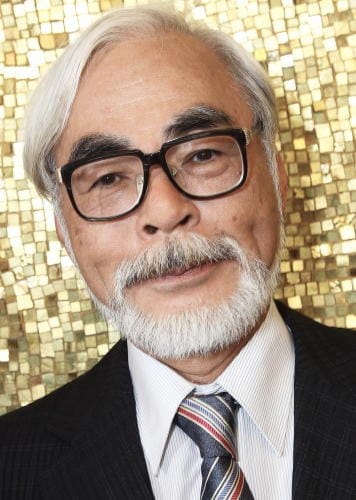
Miyazaki entered the anime industry in 1963 at Toei Animation, a studio organized around efficient, limited animation designed to stretch small budgets across broadcast schedules. He spent the next two decades pushing against that model from the inside — first as an animator chafing against its shortcuts, then as a director insisting that full, fluid, hand-drawn motion was not an indulgence but the entire point. Nausicaä of the Valley of the Wind (1984), made independently before Studio Ghibli existed as a company, became successful enough to fund the studio's 1985 founding alongside Isao Takahata and producer Toshio Suzuki. From that point forward, Ghibli operated as a direct rebuke to the industry norms Miyazaki had spent his early career resenting: expensive, meticulous, hand-drawn animation at a moment when the rest of the industry was finding ways to do more with less.
That commercial stubbornness is easy to take for granted now that Ghibli is a globally recognized brand, but it was a genuine gamble for most of the studio's history. Princess Mononoke (1997) was, at the time of its release, the most expensive animated film ever made in Japan, built on a premise — that the conflict between industrial civilization and the natural world has no side worth rooting for uncomplicated — that resists the moral clarity most blockbuster animation relies on to sell tickets. It became the highest-grossing Japanese film of its year anyway, a result that validated Miyazaki's refusal to simplify his own films' ethics for commercial safety, and set the template for everything he made afterward.
The Poetics of Things Ending
What distinguishes Miyazaki's treatment of impermanence from the generic "nothing lasts forever" sentiment found throughout children's media is his insistence that endings are generative rather than simply sad. Spirited Away (2001) does not let Chihiro keep her memories of the spirit world because the point was never the memories — it was the version of herself she became while earning them. Porco Rosso (1992) never explains or reverses its protagonist's curse because the curse is beside the point; the film is interested in what a man does with his remaining competence once his idealism has been punctured by war. Even The Wind Rises (2013), Miyazaki's most openly elegiac film and, for years, framed as his retirement statement, builds its central relationship around a tuberculosis diagnosis the narrative never treats as solvable. The woman Jiro loves is going to die, the film knows it from early on, and the story's emotional weight comes entirely from what the characters choose to build and feel in the time that remains rather than from any fantasy of averting the outcome.
This is, among other things, a recognizably Buddhist structure of thought — mono no aware, the bittersweet awareness of impermanence that runs through centuries of Japanese art and literature, rendered legible to a global mass audience through flying machines and forest spirits. Miyazaki rarely frames it in explicitly religious terms, and the films resist being reduced to philosophy lessons. But the pattern holds across nearly every feature he has directed: beauty is inseparable from its own expiration date, and the correct response to that fact is not denial but attention.
The Retirement That Wouldn't Take
Miyazaki has announced his retirement from feature filmmaking at least half a dozen times since the 1990s, and the pattern has become a running joke within anime fandom — and a genuinely useful lens on how he works. He stepped back after Princess Mononoke, then returned for Spirited Away. He called The Wind Rises his final film in 2013, then spent the next decade quietly developing what became The Boy and the Heron (2023), a film explicitly concerned with mortality, succession, and what a creator leaves behind for those who come after. It won the Academy Award for Best Animated Feature, making Miyazaki, at eighty-three, an Oscar winner for a film about the impossibility of fully letting go of the thing you built. The irony was not lost on critics, and it was almost certainly not lost on Miyazaki either.
What Happens to a Studio Built on One Vision
Studio Ghibli turned forty this year, and the anxiety surrounding that anniversary has been less about the studio's past than its future. Ghibli has never successfully transferred its creative center of gravity away from Miyazaki, despite decades of trying — Goro Miyazaki's directorial efforts have been received as competent rather than essential, and Isao Takahata, the one filmmaker whose stature rivaled Miyazaki's own, died in 2018 without a clear successor having emerged from the generation trained under either man. That succession problem is not a minor footnote; it is the practical, institutional version of the exact theme Miyazaki has spent his career examining. A studio built around hand-drawn, meticulously overseen animation cannot simply automate its way past the absence of the person who defined what "meticulous" meant in the first place.
This is, in its way, the most honest possible tribute to what Miyazaki's films have actually been arguing all along. He has spent five decades making the case that nothing good is permanent, that the forest grows back differently after the fire, that the version of a place or a person you loved will eventually be replaced by something that is not quite the same thing. Studio Ghibli's uncertain future after him is not a betrayal of that philosophy. It is the philosophy, playing out exactly as the films always said it would. Other studios built around a single uncompromising creative vision are already facing versions of the same reckoning, which suggests Ghibli's situation is less an anomaly than a preview.
Why the Films Still Matter
The danger in writing about Miyazaki is treating the body of work as settled, a canon to be catalogued rather than an argument still worth having. But the argument underneath the flying machines and forest gods has only gotten more relevant, not less, as the culture around his films has grown more invested in permanence — in franchises that never end, in characters resurrected rather than allowed to age, in IP managed explicitly to avoid the kind of loss Miyazaki builds his stories around. Against that backdrop, a filmography insisting that impermanence is not a failure to be engineered away but the actual texture of a life worth living reads less like gentle nostalgia and more like dissent. Miyazaki never built monuments. He built things that were allowed to end, and trusted that the ending would mean something. Fifty years into that project, it still does.