There is no tutorial narrator in Elden Ring (2022) who explains the Shattering. No cutscene lays out the political geography of the Lands Between. No quest marker points you toward the truth about Marika the Eternal. The world does all of that work itself — and it does it better than most games manage with hours of exposition.
That discipline is the foundation of everything FromSoftware built here. Environmental storytelling is not a new concept; game designers have invoked it since the corridors of System Shock. But Elden Ring operates at a scale and with a precision that reframes what the technique can actually accomplish when applied without compromise across an entire open world.
Geography as Ideology
The Lands Between is not a neutral backdrop. Every biome is a political argument. Limgrave — green, golden, suffused with the warmth of the Erdtree's light — reads immediately as the seat of something that was once legitimate, even sacred. Cross into Caelid and the earth itself has turned against biology: the scarlet rot does not merely infect creatures, it transforms the soil, the sky, the color temperature of reality. The visual shift from Limgrave's amber to Caelid's cancerous crimson requires no text box. The catastrophe that defines Caelid is inscribed into the landscape at a geological level.
This is not accident or aesthetic whim. Caelid's decay is the direct consequence of Malenia's battle with Radahn — a confrontation so catastrophic it permanently infected a region the size of a small country. The game never tells you this in a cutscene. It shows you through terrain. When you eventually read item descriptions that confirm the history, the land has already made you believe it.
Stormveil Castle operates on a smaller, tighter version of the same logic. The castle's layout tells you who held power and who was expendable: the main gate, broken and inaccessible, forces players through servant passages and side entrances. The ruling class's architecture is always elevated — towers, ramparts, the throne room sealed behind grotesque statues. The soldiers assigned to hold the outer walls are stationed in spaces that feel improvised, desperate. The siege was long before you arrived. The castle carries its own exhaustion.
Ruins as Argument
FromSoftware's design philosophy treats ruins not as decoration but as evidence. Every collapsed structure in Elden Ring asks the same question: what kind of civilization produces this specific wreckage?
The Academy of Raya Lucaria answers with chilling specificity. The academy is not ruined in the conventional sense — it still functions, still populated by sorcerers and scholars. But look at what they've done to the human staff: the servants transformed into crabs, the soldiers' helmets sealed shut, the grafted abominations patrolling corridors between lecture halls. The architecture is elegant, scholarly, full of light and celestial imagery. The horror is domestic. Raya Lucaria tells you that its atrocities were administrative decisions, not emergencies. The cruelty is load-bearing.
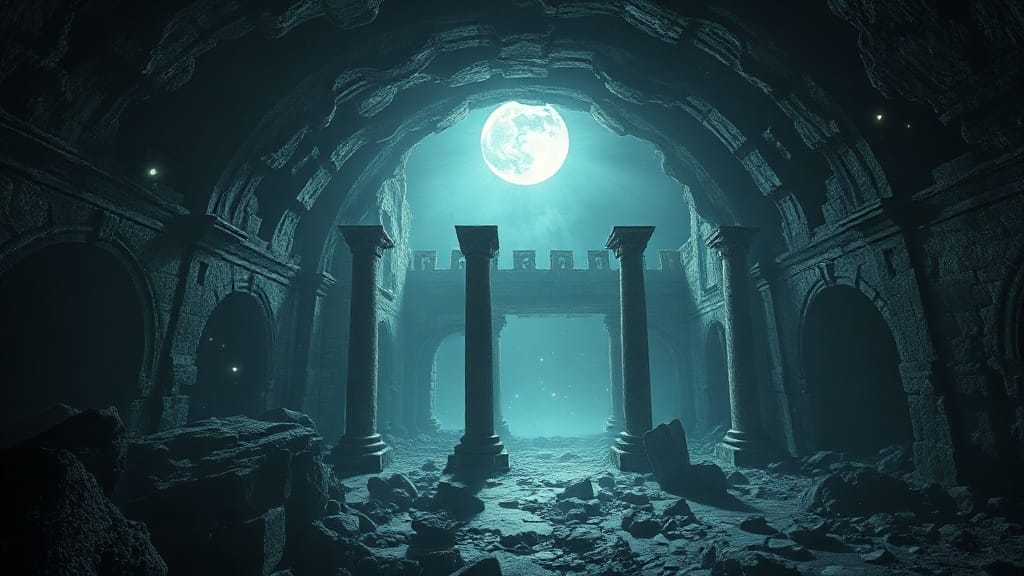
Nokron, the Eternal City, works differently. Here the catastrophe is frozen rather than ongoing — an entire underground metropolis suspended in the moment of its fall, silver tears scattered like a museum exhibit of collapse. The Nox civilization's history is legible through what they worshipped (the stars, the moon, an alternative celestial order to the Erdtree's solar dominance) and what was done to them for it (burial, erasure, imprisonment underground). No NPC delivers a lecture on the Nox. Their ideology is encoded in their architecture and their astronomical obsessions, and their punishment is encoded in the permanent darkness above their skyline.
The Negative Space of NPCs
The characters who inhabit the Lands Between function less as storytellers and more as symptoms. Their fragmentation — cryptic dialogue, interrupted sentences, beliefs that don't quite cohere — mirrors the fragmentation of the world itself. The Shattering was not just a political event; it was an epistemic one. Nobody in this world has a complete account of what happened because the event itself destroyed the conditions for complete accounts.
Sorcerer Rogier is the clearest example of this principle. His obsession with the Black Knives Conspiracy draws the player into the deepest layer of the game's political history — the assassination of Godwyn, the origins of the Omen curse, Ranni's coup against the Golden Order. But Rogier doesn't lecture. He asks questions. He dies without all his answers. His incompleteness is the point: the world's history is not a file waiting to be unlocked. It's a wound that still refuses to close.
Item Descriptions as Compressed Architecture
The game's item description system functions as a secondary layer of environmental storytelling — one that rewards players who treat inventory management as close reading. A single armor set can contain three or four sentences that recontextualize a location you explored hours earlier. The Fingerprint Stone Shield's description doesn't just explain a mechanic. It tells you that someone in the Subterranean Shunning-Grounds built a religion around the Two Fingers so extreme that even the Golden Order found it excessive. That detail reframes an entire underground dungeon retroactively. The item is a key to a room you've already left.
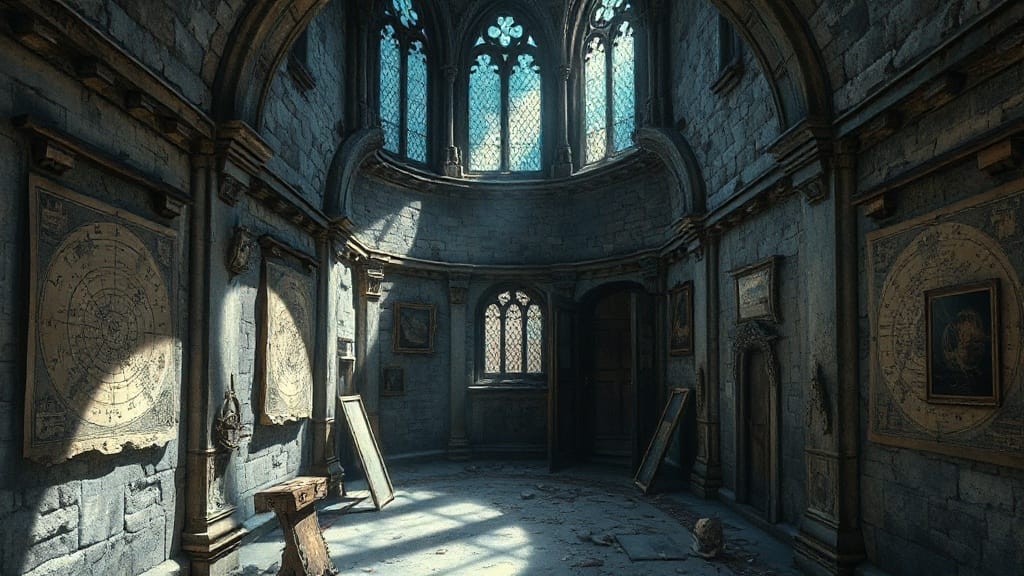
This architecture of delayed revelation is only possible because the environmental design established the questions first. The player encounters the Shunning-Grounds as a place that feels wrong — too devoted, too deep, too hidden — before any text confirms why. The wrongness is felt spatially, then confirmed linguistically. Neither layer is sufficient alone.
What This Demands of the Player
The critique leveled at FromSoftware's approach — that it is obscurantist, exclusionary, inaccessible — misidentifies the transaction the game is proposing. Elden Ring does not withhold its story as a power flex. It withholds the narration because narration would flatten what the environment communicates volumetrically. A voiced cutscene explaining the Erdtree's political function would reduce a theological symbol visible from every corner of a continent to a piece of lore trivia.
The Erdtree works as a storytelling device precisely because it is always present, always dominating the skyline, always golden in a world increasingly defined by things the gold cannot reach or fix. Its omnipresence is the argument. You cannot cut that to a loading screen tip.
What the game demands is the willingness to read space the way you read text — to treat a staircase's width, a room's emptiness, a skeleton's location as intentional sentences. That is not an unreasonable demand. It is, in fact, the oldest form of storytelling architecture ever practiced. FromSoftware simply had the discipline to trust it at scale.
The Lands Between does not have a narrator because it does not need one. The world already knows everything. It is waiting to see if you are paying attention.
 Official trailer